
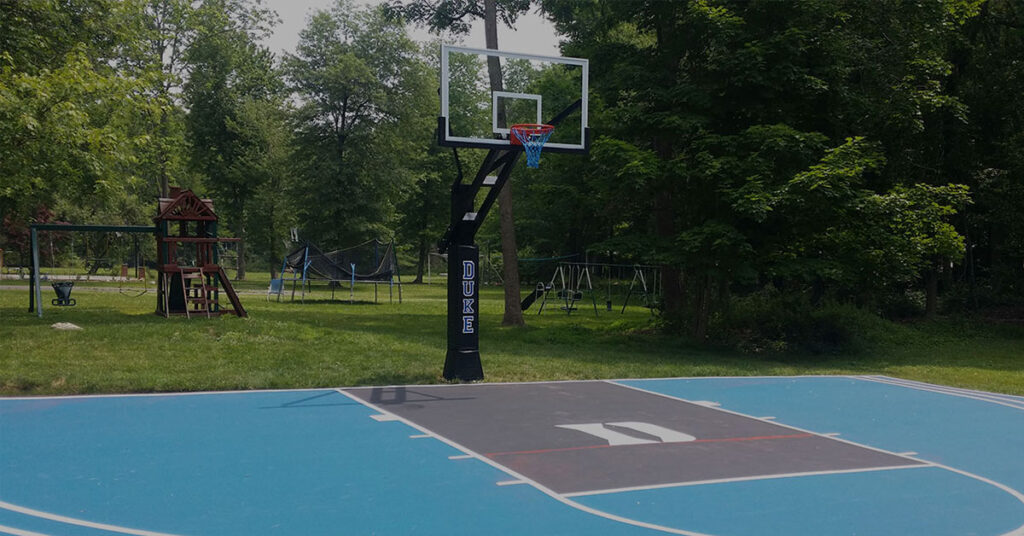
A tempered glass backboard is a clear, rigid board heat treated to about four to five times the strength of ordinary glass. It gives excellent rebound and stability, and glass is what FIBA requires at its elite level of play. If you are building a serious home court and your pole is sized to carry it, glass is the board to choose.
Key Takeaways
- Elite play runs on glass. FIBA requires tempered or laminated glass about half an inch thick at its top level.
- Tempered glass is heated to about 1,200°F and cooled fast, so if it breaks, it falls apart in small, cube-like pieces.
- Acrylic and polycarbonate cost less and are harder to damage, but glass is the elite standard for rebound and stability.
- A 72 by 42 inch board is NBA regulation size. The 54 and 60 inch glass boards suit driveways and half courts.
- Tempered glass cannot be cut once it is made, so a replacement board has to match your frame exactly.
What Are Basketball Backboards Made Of?
Clear backboards come in three materials: tempered glass, acrylic or polycarbonate. Solid boards are also made of wood, fiberglass, steel or aluminum, painted white.
The pro rulebooks set the bar. The NBA’s Rule 1 calls for a transparent board 6 feet wide and 3.5 feet tall, with a 24 by 18 inch white rectangle marked behind the rim.
FIBA’s 2026 equipment rules are stricter. For national team and elite club games, the board must be laminated safety glass or tempered glass roughly half an inch (11.8 to 13.5 mm) thick. Acrylic, polycarbonate and painted boards are allowed only in lower competitions.
Why a Tempered Glass Backboard Plays Better
A backboard has one job: send the ball back the same way every time. Glass is stiff, and on a quality hoop it sits in a sturdy metal frame, so the board stays steady when the ball hits it.
FIBA even tests for this. At its top level, a ball dropped onto the board from about 5.9 feet (1.8 m) must bounce back to at least half that height.
Lifetime, which makes hoops in all three materials, credits tempered glass with excellent rebound and stability. It also says steel-framed acrylic and polycarbonate boards rebound similar to glass. So the frame matters, not just the panel.
What That Means on Your Court
- Bank shots. A steady board sends the ball off at a consistent angle, so your player can build a touch they trust.
- Rebounds. Misses come off at a predictable distance, which makes box out and putback drills worth running.
- Sightlines. Clear glass keeps the view open for anyone watching from the patio.
How Tempered Glass Is Made and Why It Breaks More Safely
Tempered glass starts as ordinary flat glass. According to Vitro’s technical guide to heat-treated glass, the sheet is heated to about 1,200°F and then force cooled very quickly, a step called quenching.
Quenching locks the outer surfaces in compression. The ASTM C1048 standard requires at least 10,000 psi of surface compression, and the result is about four to five times as strong as untreated glass of the same thickness.
The bigger safety gain is how it fails. Tempered glass is designed to break into countless small, roughly cubical pieces. That break pattern is what qualifies it as safety glazing, and Vitro says small pieces lower the risk of serious cuts.
What Keeps a Glass Board in One Piece
- A rim mounted to the frame. FIBA requires the rim plate to have no direct contact with the glass, so force on the rim never reaches the board.
- A breakaway rim. The NBA requires pressure-release rims. Under FIBA specs, the rim tips down 10 to 30 degrees when it releases, then snaps back on its own.
- Healthy edges. In window glass, Vitro reports that most unexplained breaks trace back to old edge or surface damage, or glass rubbing on metal. Treat backboard edges with the same care.
- No hanging. Goalrilla’s warranty excludes hanging on the rim, net or backboard.
Safety tip: If a glass board ever breaks, keep everyone off the court until it is cleaned up. The pieces are small but still glass, so wear gloves and closed shoes and sweep the grass edges too.
Tempered Glass vs Acrylic vs Polycarbonate Backboards
Here is how the three clear materials stack up for a home court. The table draws on FIBA’s rules, Vitro, Lifetime and backboard maker First Team.
| Feature | Tempered glass | Acrylic | Polycarbonate |
|---|---|---|---|
| Elite FIBA play | Required, tempered or laminated | Lower levels only | Lower levels only |
| Rebound | Excellent rebound and stability | Close to glass if steel framed | Close to glass if steel framed |
| Impact | 4 to 5 times plain glass, but can break | Thrown rocks tend to bounce off | Does not crack or chip when hit |
| Lifetime lineup | High-end in-ground hoops | Beginner and mid-level hoops | Mid-level and advanced hoops |
| Price | Highest of the three | Less than glass | Less than glass |
Acrylic vs Glass Backboard
Acrylic sits at the entry end of the range. Lifetime fits its acrylic boards to beginner and intermediate systems and keeps glass for its high-end in-ground hoops.
The right pick depends on who shoots there. A player aiming for school or club ball gets the most from glass, the material elite rules require. For young kids shooting for fun, a steel-framed acrylic board plays well and costs less.
Polycarbonate vs Acrylic Backboard
Polycarbonate handles impact best. Lifetime says it does not crack or chip when struck and is stronger than acrylic. That toughness suits public courts where boards take a beating.
Sunlight is the catch. Polycarbonate maker Palram says unprotected polycarbonate yellows over time, which is why quality sheets carry a thin UV layer. First Team says acrylic is unaffected by UV and claims outdoor polycarbonate boards can turn yellow, cloudy and brittle within 3 to 5 years.
Glass Backboard Sizes: 54, 60 or 72 Inches?
Lifetime’s backboard guide lists tempered glass boards at 50, 54, 60 and 72 inches wide. Goalrilla builds its FT glass line in 54, 60 and 72 inch widths. The 72 by 42 inch size matches the NBA’s regulation board.
| Width | Board face | Goalrilla FT spec | Best fit |
|---|---|---|---|
| 54 in | 54 by 36 in | 3/8 in glass, 5 in pole, 3 ft overhang | Driveways, compact half courts |
| 60 in | 60 by 38 in | 3/8 in glass, 5.5 in pole, 3.5 ft overhang | Wide driveways, family half courts |
| 72 in | 72 by 42 in | 3/8 in glass, 6 in pole, 4 ft overhang | Full backyard courts, competitive players |
Notice the pattern. Every step up in glass brings a thicker pole and a longer reach, since a bigger pane of the same 3/8 inch glass weighs more. Our guide to the elements of a quality basketball hoop covers poles, overhang and anchors in depth.
Which Size Should You Choose?
- 54 inch. The most compact of the three. It fits a standard driveway and still gives you the glass bounce.
- 60 inch. A middle ground for a wider driveway or a family half court.
- 72 inch. Regulation width. It belongs on a dedicated home outdoor basketball court where players train for school or club ball.
What to Check on a Basketball Hoop With a Glass Backboard
- The glass itself. The spec sheet should say tempered glass and list the thickness.
- A metal frame around the edges. FIBA requires a protective frame around the outer edge of elite glass boards.
- A rim mounted to the frame, not the glass. The rim plate should bolt to the frame or arm, so rim force never reaches the panel.
- A breakaway rim. It tips down under a hard dunk and springs back, a feature FIBA requires at its top level.
- Edge padding. FIBA requires padding on the backboard, and a padded bottom edge protects heads and hands at home too.
- A pole sized for the board. Set in concrete to the maker’s spec, so the glass does not shake after every shot.
Still deciding between in-ground, portable and wall-mounted hoops? Read our breakdown of the pros and cons of basketball hoops. For adjustable height and other upgrades, see the latest home basketball technology.
Caring For and Replacing a Glass Backboard
Glass needs little upkeep. Goalrilla tells owners to rinse the board with lukewarm water, wash it gently with mild soap and a soft 100% cotton cloth, and never scrub.
A few times a season, look over the edges and the frame. Tighten loose hardware and make sure no bare metal touches the glass.
Glass Backboard Replacement
Vitro notes that tempered glass cannot be safely cut after heat treatment. Nobody can trim a new board to fit, so the replacement must match your frame’s size and bolt pattern exactly.
- Find the brand and model number of your hoop.
- Measure the board’s width and height and note how it bolts to the frame.
- Order the matching board from the manufacturer or an authorized dealer.
- Have at least two people, or a professional crew, handle the lift and mounting.
If the model is discontinued or the pole is damaged too, a new system may make more sense. We sell and install hoops, including on the residential courts we build.
Tip: Take a photo of the model label and the bolt pattern before you call anyone. It saves a round of back and forth and helps avoid ordering the wrong board.
Frequently Asked Questions About Glass Backboards
Is a tempered glass backboard worth it for a home court?
For players who compete, usually yes. Glass gives excellent rebound and stability, and FIBA requires glass at its elite level. It costs more than acrylic or polycarbonate, and it needs a sturdy pole sized for the board. For young kids shooting casually, a steel-framed acrylic board plays well for less money.
Which is better, a polycarbonate or acrylic backboard?
It depends on where the hoop lives. Polycarbonate resists impact best, so it suits parks and schools where boards take abuse. Outdoors, though, unprotected polycarbonate yellows in sunlight, while acrylic is unaffected by UV. That is why backboard maker First Team recommends acrylic for outdoor hoops. For serious players, glass is still the step up.
How thick is a glass basketball backboard?
FIBA’s elite-level rules call for glass roughly half an inch (11.8 to 13.5 mm) thick. Home systems can be thinner: Goalrilla’s 54, 60 and 72 inch FT models all list 3/8 inch tempered glass. A stiff frame and a pole sized for the board matter as much as the glass itself.
Can a tempered glass backboard shatter?
Yes, it can. Tempered glass is about four to five times stronger than ordinary glass, and when it fails it breaks into small, cube-like pieces that are less likely to cause serious cuts. To lower the risk, use a breakaway rim mounted to the frame, keep players off the rim, and replace any board with chipped edges.
What is the best backboard for an outdoor hoop?
For serious play, choose tempered glass on an in-ground pole set in concrete. Goalrilla’s FT series and Lifetime’s high-end in-ground hoops both use glass. If budget rules out glass, First Team recommends acrylic over polycarbonate outdoors, since acrylic is unaffected by UV. If older kids play hard, pick a steel-framed board.
Planning a Home Court With a Glass Backboard?
My Backyard Sports designs and builds custom basketball courts and sells and installs hoops, so the hoop and the court surface are planned together. Tell us about your space and we will measure it and recommend a layout.