
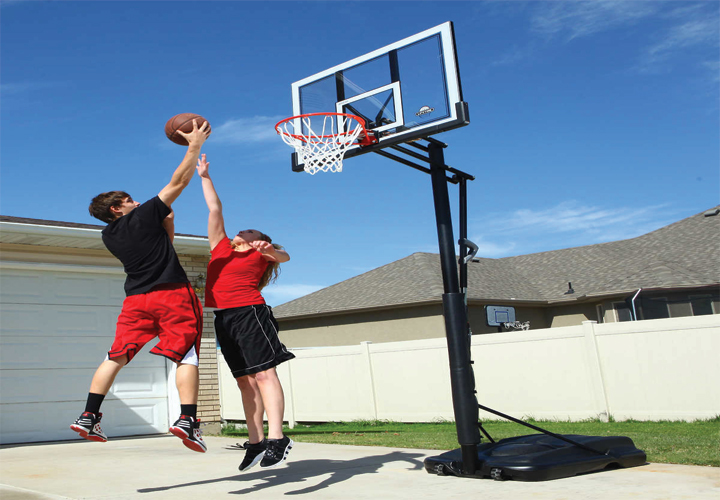
There are four main types of basketball hoops: in-ground, portable, wall or roof mounted, and indoor mini hoops. In-ground hoops set in concrete are the steadiest. Portables sit on a weighted base and suit renters and shared driveways. Wall mounts save space at a garage, and over-the-door mini hoops bring the game inside. Choose by where you play, who shoots and how long you plan to stay.
Key Takeaways
- In-ground hoops give the most stable, gym-like play. Goalrilla’s anchor spec calls for a hole 16 inches wide and 48 inches deep.
- Full-height portables come with boards such as 44, 50, 54, 60 and even 72 inches. Goalrilla pairs 54 inches with a one-car driveway.
- Fill a portable base with sand if you can. Lifetime says sand is about 45% denser than water and does not evaporate.
- Wall and roof mounts need solid framing, and some mounting kits lock the rim at one height.
- Over-the-door mini hoops are for playrooms and offices, not for building a real jump shot.
Types of Basketball Hoops Compared at a Glance
Each type trades stability for flexibility in its own way.
| Hoop type | Best for | Biggest pro | Biggest con |
|---|---|---|---|
| In-ground | Backyard courts and driveways you own | Steadiest rim and truest rebound | Needs a concrete footing |
| Portable | Renters, shared driveways, young kids | Rolls to a new spot or a new house | More shake; base must stay full |
| Wall or roof mount | Garage fronts, barns, gyms | No pole or base on the playing area | Fixed spot; needs solid framing |
| Indoor mini | Bedrooms, playrooms, offices | Cheap, simple, no install | Tiny rim does not train a real shot |
In-Ground Basketball Hoops: Pros and Cons
An in-ground hoop is a steel pole locked into a concrete footing. It comes closest to the feel of a gym basket.
How In-Ground Hoops Go In
Some poles are buried straight in the concrete. Others bolt onto an anchor kit cast in the footing first. Goalrilla says its anchor lets you level the pole after the pour and remove the hoop if you move.
The Goalrilla installation guide gives a typical anchor spec: a hole 16 inches across and 48 inches deep, eleven 80 pound bags of concrete, and at least 72 hours of cure time before the pole goes up. It also asks for three capable helpers and a call to your local utilities before anyone digs.
In-Ground Hoop Pros
- Stability. A pole set in concrete shakes far less after a hard rebound or a dunk.
- Bigger boards. Goalrilla sells in-ground systems with 54, 60 and 72 inch backboards.
- Height that grows with your kids. Lifetime’s 50 inch in-ground model adjusts from 7.5 to 10 feet with one hand.
In-Ground Hoop Cons
- Real site work. You pay for digging, concrete and labor on top of the hoop, then wait for the cure.
- It stays put. A direct-bury pole cannot come with you to a new house.
An in-ground system is the natural match for a new backyard basketball court, where the hoop, the slab and the lines are planned together.
Portable Basketball Hoops: Pros and Cons
Portable basketball hoops stand on a hollow plastic base that you fill with water or sand. Wheels on the base let you tip the hoop and roll it to a new spot.
Portable Hoop Pros
- No digging. Assemble it, fill the base and play.
- It moves with you. Good for renters and families who may relocate.
- Adjustable rims. Many models, such as Lifetime’s 54 inch portables, adjust from 7.5 to 10 feet.
Portable Hoop Cons
- More shake, no dunking. Goalrilla’s buying guide says portables cannot handle rough play such as dunking, because they can tip or fall.
- The base does all the work. Lifetime warns that a leak can drain a water base unnoticed, and the hoop could fall.
- It takes up driveway. The base on Spalding’s The Beast portable measures about 63 by 36 inches.
Sand or Water in the Base?
Lifetime’s guide on how to fill a portable basketball base recommends sand, because it is denser and makes the pole and board much steadier. The catch is that a sand-filled base is very hard to empty later.
Water is cheaper and easier to get. If you use it, check the level often, since water evaporates over time.
Safety: A portable hoop is only as steady as its base. Before you buy one for young kids, read our guide to the dangers of a portable basketball hoop.
Portable Hoop Backboard Sizes: 44, 50, 54 and 60 Inch
The number in a portable hoop’s name is the backboard width. Bigger boards usually ride on bigger bases and thicker poles.
| Board width | Example specs | Good fit for |
|---|---|---|
| 44 inch | Lifetime Impact: 12 gallon base, 2.75 in pole, 7.5 to 10 ft | Young kids, short driveways |
| 50 inch | Lifetime Fusion: 31 gallon base, 3 in pole, 8 to 10 ft | Everyday family games |
| 54 inch | Lifetime steel framed: 3.5 in pole, 7.5 to 10 ft | Teens and regular pickup games |
| 60 inch | Spalding The Beast line: 40 or 55 gallon base, 4 or 5 in pole | Serious players who still need wheels |
| 72 inch | NBA width; The Beast also offers it | Gym-style play on a wide driveway |
Is a 50 Inch Portable Basketball Hoop Big Enough?
For younger players and casual family games, yes. A 50 inch board gives a clear target for layups and bank shots. Lifetime’s 50 inch model also drops to 8 feet, the rim height USA Basketball suggests for ages 7 and 8.
Is a 54 Inch Backboard Worth the Step Up?
If teenagers shoot most days, it usually is. The 54 inch Lifetime portables use a thicker 3.5 inch pole than the 50 inch model. Goalrilla’s guide also pairs a 54 inch board with a one-car driveway.
When a 60 Inch Portable Basketball Hoop Makes Sense
A 60 inch board looks and plays closer to a gym basket. Spalding’s The Beast, sold with a 54, 60 or 72 inch board, uses a 40 or 55 gallon base and a 7.5 to 10 foot screw jack lift. Once filled, it is heavy to move.
Wall-Mounted and Roof-Mounted Basketball Hoops: Pros and Cons
A wall mount bolts a backboard and extension arm to a garage, barn or gym wall. A roof mount does the same job from the roofline above the garage door.
Wall Mount Pros
- A clear driveway. No pole or base for players to hit.
- Adjustable options exist. Goalrilla’s Silverback NXT 54 wall mount pairs a 54 by 33 inch board with a 2.5 foot overhang and adjusts from 7.5 to 10 feet.
Wall Mount Cons
- A fixed spot. You play wherever the wall is.
- Some kits are fixed height. Lifetime’s universal mounting kit is non-adjustable, and the hardware to fasten it to a roof or wall is not included.
- The structure matters. The Silverback NXT listing says to avoid any brick surface or facade. On an attached garage, the thud of missed shots can carry into the house.
Indoor and Mini Basketball Hoops: Over-the-Door and Playroom Options
Mini hoops hang on a door or wall and use a soft or undersized ball. Think of them as toys and warm-up tools.
- Foam over-the-door hoops. The Nerf Nerfoop hooks over a door and comes with a 4 inch foam ball. Hasbro rates it for ages 4 and up and calls it a Nerf favorite for almost 50 years.
- Pro-style mini hoops. The SKLZ Pro Mini Hoop Flip has an 18 by 12 inch polycarbonate board, a 9 inch breakaway rim and a 5 inch rubber ball. Foam-padded mounts slide over the door.
- Youth hoops. For small kids ready for more, Lifetime’s youth portable pairs a 32 inch board with a height range of 5.5 to 7.5 feet.
They cost little and need no install, but they will not build a full-size shot.
In-Ground vs Portable Basketball Hoop: How to Choose
Use this checklist before you buy.
- Do you own the home and plan to stay? If yes, lean in-ground. If not, a portable or an anchor-mounted pole keeps your options open.
- Who will shoot? Match the rim to the players using the chart below, and make sure the hoop drops low enough.
- How hard will they play? Daily games and dunks call for steel in concrete and a 54 inch or larger board.
- What is under the spot? Buried utilities, roots and slopes all change the plan. Call before you dig.
- What surface will you land on? See our take on soft outdoor basketball courts.
| Age | Rim height | Ball size |
|---|---|---|
| 7 and 8 | 8 ft | Size 5 (27.5 in) |
| 9 to 11 | 9 ft | Size 6 (28.5 in) |
| 12 to 14 | 10 ft | Girls size 6, boys size 7 (29.5 in) |
| High school | 10 ft | Girls size 6, boys size 7 |
The full chart, with court sizes and free throw distances, is in the USA Basketball youth guidelines. A hoop that adjusts from 7.5 to 10 feet covers every row.
Which Backboard Comes With Each Hoop Type?
Board material tends to follow hoop type. Lifetime’s own backboard guide puts high-density polyethylene on many beginner portables, polycarbonate on most intermediate and advanced portable and in-ground hoops, and tempered glass on most high-end in-ground systems.
If you want a true gym bounce at home, read why we favor a tempered glass backboard for a home court. For poles, rims and anchors in detail, see what makes a quality basketball hoop.
Frequently Asked Questions About Types of Basketball Hoops
What is the best type of basketball hoop for a driveway?
If you own the home, an in-ground hoop set beside the driveway gives the steadiest play. If you rent or share the driveway, a portable is the practical pick. Goalrilla suggests a 54 inch board for a one-car driveway and 60 to 72 inches for two or three cars wide. A wall mount works when a strong garage wall faces a flat apron.
What is the NBA standard backboard size?
NBA rules call for a rectangular backboard 6 feet wide and 3.5 feet tall, which is 72 by 42 inches, with a flat, transparent face. The rim is 18 inches in inside diameter, its top edge sits 10 feet above the floor, and its nearest inside edge is 6 inches from the board. You can read it in NBA Rule No. 1.
Is an in-ground hoop better than a portable hoop?
For play quality, yes. A pole in concrete shakes less, will not tip and handles hard play better. A portable wins on flexibility, because it needs no digging and moves with you. A sensible path is a portable while kids are small, then an in-ground system with a proper court.
Can you put a basketball hoop on a garage?
Yes, with a wall or roof mount on solid structure. Goalrilla’s Silverback NXT listing says to avoid brick surfaces and facades, and neither that kit nor Lifetime’s mounting kit includes the fasteners for your wall. Check whether the kit adjusts, because some lock the rim at one height.
Are over-the-door mini hoops good for kids?
They are great for fun and hand-eye practice in small spaces. The Nerf Nerfoop uses a 4 inch foam ball and is rated for ages 4 and up. For real shooting form, kids still need a proper ball on a rim set to their age, such as 8 feet for ages 7 and 8.
Want the Right Hoop on the Right Court?
My Backyard Sports sells and installs basketball hoops and builds the half and full courts they stand on, with our own crews handling the base, surface, hoop and lines. Tell us about your space and we will measure it and recommend a layout.