
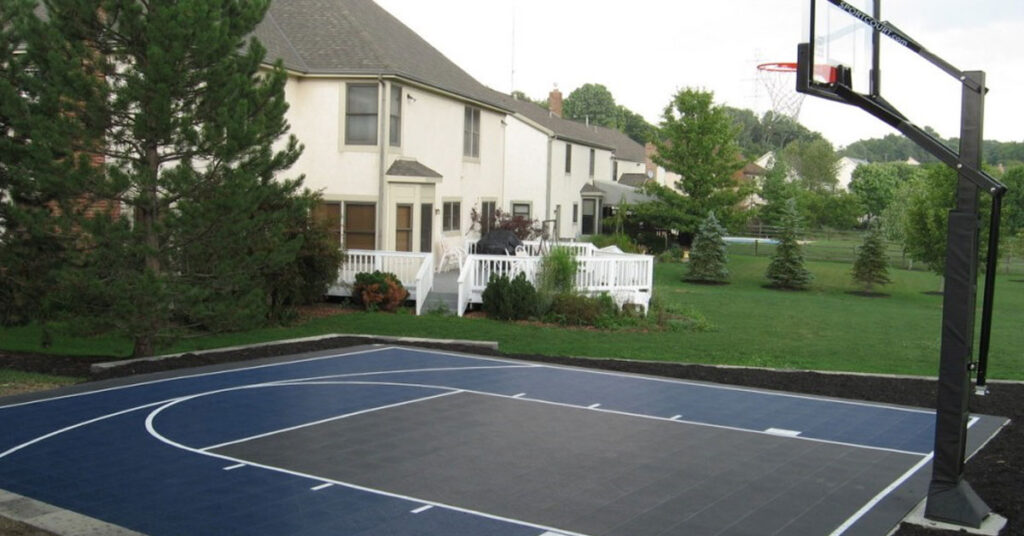
The home basketball court technology worth buying is the gear that turns yard time into quality reps. Put your money first into a cushioned tile surface, a hoop that adjusts as kids grow, a ball return and good lighting. Then add free shot tracking on a phone. Smart hoops and shooting machines are great extras once the court itself is right.
Key Takeaways
- Build the court first: a cushioned surface and a solid in-ground hoop beat any gadget.
- USA Basketball recommends 8 foot rims for ages 7 and 8 and 9 foot rims for ages 9 to 11, so an adjuster pays off.
- Free camera apps now count makes and misses on an iPhone or iPad, with no sensors and no smart ball.
- A clip-on ball return lists under $50. Dr. Dish’s home shooting machine lists near $3,000 and needs a 120 volt outlet.
- Plan power and lights before the surface goes down.
Home Basketball Court Technology: What Is Worth It?
These are the modern home basketball court features that matter. Specs and prices come from the makers’ own pages, so treat them as a snapshot.
| Upgrade | What is new | Worth it if |
|---|---|---|
| Height adjuster | Lift handles, steel actuators, drill power | You have kids under 12 |
| Breakaway rim | Spring rim flexes on dunks, then snaps back | Teens will dunk |
| Shot tracking app | Phone camera AI logs every shot | You want stats for free |
| Smart hoop kit | Sensor hub, shot charts, make and miss lights | Your player loves games and data |
| Ball return or net | Chutes send makes back, nets stop misses | Someone shoots alone often |
| Shooting machine | Automatic passes, drills and stat saving | A serious player trains daily |
| Cushioned tiles | Shock absorbing, fast draining surface | You are building or resurfacing |
| LED lighting | Efficient, shielded, motion or timer control | You play after dark |
Adjustable Basketball Hoops: Cranks, Handles and Power Drills
Kids build better form when the rim is within their range. That is why the USA Basketball youth guidelines lower the basket for younger players.
| Age group | Rim height | Ball size |
|---|---|---|
| 7 to 8 | 8 ft | Size 5 (27.5 in) |
| 9 to 11 | 9 ft | Size 6 (28.5 in) |
| 12 to 14 | 10 ft | Girls size 6, boys size 7 (29.5 in) |
| High school | 10 ft | Girls size 6, boys size 7 |
The same guidelines move the free throw line in to 14 feet for the two younger groups. Adjusters come in four common styles:
- Screw jack crank. Spalding’s The Beast portable uses one for infinite settings from 7.5 to 10 feet.
- One-hand lift handle. Lifetime’s Power Lift moves the board from 7.5 to 10 feet in any increment.
- Steel actuator. Goalrilla’s CV in-ground hoops use an all-steel actuator over that same range.
- Drill powered. Pro Dunk says its THOR hoop goes from 5 to 10 feet in under 10 seconds with a power drill.
Any of these covers the 8 and 9 foot settings young players need.
Breakaway Rims: A Pro Safety Standard for the Backyard
A breakaway rim flexes down under a heavy load, then springs back. The FIBA equipment rules require one for top-level play. Its lock must hold until roughly 180 to 230 pounds (82 to 105 kg) presses down on the front of the ring. Then the ring tips 10 to 30 degrees and snaps back on its own.
On home basketball hoops, Goalrilla explains, a breakaway rim sends a dunk’s shock into the pole instead of the backboard.
Our guide to tempered glass backboards explains why glass plays best. For rim types, poles and overhang, read our basketball hoop buying guide.
Basketball Shot Tracking: Apps, Smart Balls and Smart Hoops
Shot tracking gives home basketball players feedback that once took a coach with a clipboard.
Phone Apps and Smart Balls
HomeCourt uses an iPhone or iPad camera and AI to find the rim and log your shots. Its maker says the app is free to use and needs no sensors or smart ball. For advanced tracking, set the phone on a small tripod and use the rear camera.
The paid HomeCourt+ membership adds deeper analysis, such as release time and release angle, plus your full workout history. Noah Basketball’s HOOPS app tracks shots on an iPhone too and adds games like Knockout.
A smart ball is a different tool. DribbleUp’s Smart Basketball pairs with an app that tracks dribbling speed, accuracy and consistency, so it trains ball handling rather than shooting.
Smart Hoops and Retrofit Kits
The huupe ARENA Upgrade Kit mounts an IP65 weatherproof sensor hub on a hoop you already own and plugs into a standard 120 volt outlet. It links to a phone app by Bluetooth, with no home Wi-Fi needed.
The free Basic tier counts makes and field goal percentage. Shot charts, rim charts and AI form analysis need a paid plan. Optional LED lights around the backboard can flash green for a swish, yellow for a make off the rim and red for a miss in some games.
Target Numbers for Arc, Depth and Aim
After tracking hundreds of millions of shots, Noah Basketball found make rates peak with a 45 degree entry angle and the ball about 11 inches deep, which is 2 inches past the center of the rim.
Noah also wants shots within 3 inches of center from left to right. Share those three targets with your player.
Rebounders, Ball Returns and Shooting Machines
Chasing the ball eats practice time. Ball returns fix that at almost any budget.
- Clip-on chute. The SKLZ Kick-Out attaches to the hoop and uses a 360 degree chute to send made shots back out. It lists at $44.95.
- Mounted return ramp. Goalrilla’s ball return rotates 180 degrees to face any shooting spot and works with 27.5, 28.5 and 29.5 inch balls.
- Rebounding net. Goalrilla’s Yard Guard spans more than 12 feet wide and up to 9 feet tall, so misses stay on the court.
- Automated machine. Dr. Dish Home rebounds and passes up to 1,200 shots per hour and saves stats to an app.
Machines take planning. Dr. Dish lists the Home model at 275 pounds on locking wheels, with a net about 11.5 to 12 feet high. It runs on a standard 120 volt outlet and needs Wi-Fi to save stats. At this writing it lists at $2,995 plus a $39 monthly membership for some features, or $3,990 with no monthly fee.
Tip: If a shooting machine or smart hoop is on the wish list, have a licensed electrician run an outdoor outlet near the baseline before the court surface goes in. Adding it later can mean lifting tiles or cutting pavement.
Cushioned Home Basketball Surfaces Beat Bare Concrete
Modular sport tiles snap together over a concrete or asphalt base and add a little give underfoot.
VersaCourt’s Game outdoor tile, for example, is a 3/4 inch shock-absorbing tile molded from polypropylene with UV stabilizers. Its open grid drains rain, and spring tabs let tiles shift slightly side to side to ease stress on knees and lower backs.
VersaCourt’s spec sheet for its Compete indoor tile lists 95.2% vertical rebound under ASTM F2117, a standard ball bounce test for sports surfaces.
Our article on soft outdoor basketball courts compares tiles with concrete and asphalt, or you can browse the sport tiles we install. Tile courts can also carry pickleball or custom lines, set into the tile along with logos or a family name.
Basketball Court Lighting: LED, Solar and Motion Control
For night play, LEDs are the clear choice. ENERGY STAR says LED products make light up to 90% more efficiently than incandescent bulbs.
VersaCourt rates its LED court light at 37.5% of the power of a comparable 400 watt metal halide fixture, with a life of about 45,000 hours. Solar skips the wiring. Goalrilla’s solar hoop light mounts on the pole, aims 4,000 lumens down at the court and can switch on with motion.
Be a good neighbor as well. DarkSky International’s lighting principles ask for light only where and when it is needed. Shield fixtures and aim them down, keep them no brighter than necessary, use timers or motion sensors, and pick warmer colors.
Where to Spend First: A Build Order Checklist
Spend first on what is hard to change later. Gadgets can be added any season.
- A flat, well-drained base topped with a cushioned tile surface.
- An in-ground hoop with a height adjuster and a breakaway rim.
- Power and conduit for lights, a machine or a smart hoop.
- Shielded LED lighting on a timer or motion sensor.
- A ball return or rebounding net behind the hoop.
- A free tracking app, then a smart hoop kit or machine for a committed player.
Starting from scratch? See how we plan residential sport courts.
Frequently Asked Questions About Home Basketball Court Technology
What is a smart basketball hoop?
A smart basketball hoop uses built-in sensors to count makes and misses and send the stats to an app. Some add backboard lights that react to each shot, and some mini hoops add a screen. Systems like huupe run on standard 120 volt power, so plan for an outlet near the pole or a portable power station.
Can you track basketball shots without a smart ball?
Yes. Camera apps such as HomeCourt run on an iPhone or iPad and use AI to find the rim and log each shot, with no sensors on the ball or the hoop. Smart balls like DribbleUp focus more on dribbling drills than on shooting.
Is a basketball return net worth it?
For anyone who shoots alone, yes. A clip-on chute under $50 sends makes back to you, and a rebounding net behind the hoop keeps misses out of the yard and the street. A shooting machine rebounds every shot, but it costs thousands and needs power.
Build a Court Ready for Modern Basketball Tech
My Backyard Sports designs and builds custom home basketball courts with cushioned tile surfaces, pro-grade hoops and regulation or custom lines. Tell us what gear you want when we measure your space, and we will lay out the court around it.