
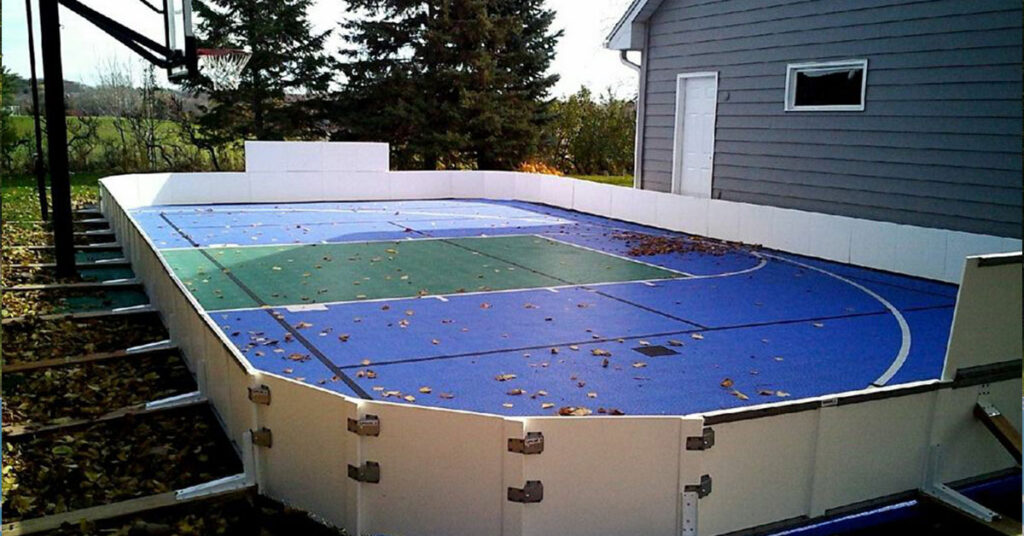
Plan on a backyard sport court permit, or at least a zoning review, any time you add a paved pad or move a lot of soil. Tall fences, high retaining walls, lights and new wiring usually need their own permits. Zoning decides where a court can sit and how much of the lot it may cover, and the building department handles the rest.
Key Takeaways
- Zoning comes first. Setbacks, lot coverage and location rules decide whether a court fits at all.
- In New Jersey, fences over 6 feet, retaining walls 4 feet or taller and new wiring all need construction permits.
- Disturbing more than 5,000 square feet of soil in New Jersey requires a certified erosion control plan.
- A 12 foot tall batting cage is too tall for New Jersey’s permit exemptions for fences and sheds.
- Surveys, drainage and permit work belong in every sport court price you compare.
What Goes Into a Backyard Sports Court?
A sports court is a stack of layers, and the painted lines are the last one. Our own crews handle the base, surfacing, hoops and line painting, and most layers raise a question for the town or your HOA.
| Component | What it does | What reviewers ask |
|---|---|---|
| Excavation and grading | Levels the site and sets the slope | How much soil moves and where rain goes |
| Stone or concrete base | Carries the surface and resists frost | How much lot coverage it adds |
| Sport tiles or acrylic coating | Sets bounce, grip and color | Color, if an HOA controls it |
| Hoops and net posts | Anchored in concrete footings | Whether they sit inside the setbacks |
| Fencing or ball stop netting | Keeps balls in your yard | Height limit and material |
| Lighting | Extends play after dark | Electrical permit, glare and hours |
| Drainage | Moves runoff away from the pad | Grading or stormwater plan |
Most approval questions sit below and around the playing surface, so the site plan matters more than the court color. Our sports construction services run from design and planning through final line painting.
When Does a Backyard Sport Court Permit Apply?
Approvals come from several places: your town’s zoning ordinance, the state building code, soil and stormwater rules, and any private covenants on your property. Sport court zoning rules are usually the first hurdle.
Paving and Lot Coverage
Many zoning codes cap impervious cover, the share of a lot under roofs and hard surfaces. A concrete or asphalt court counts toward it just like a patio or driveway.
On a lot with a large house and a long driveway, that cap often sets the court size before the yard does. Some towns treat permeable builds differently, and our guide to permeable sport courts explains how they handle rainwater.
Setbacks and Location
Setbacks are minimum distances between the court and your property lines. Each town sets its own, and some also require the court to sit behind the house, so get the figures in writing before you design.
Grading, Drainage and Soil Disturbance
Moving soil changes where rain goes, so expect questions about slope, swales and where runoff ends up.
In New Jersey, any project that will disturb more than 5,000 square feet needs a Soil Erosion and Sediment Control Plan certified by your local soil conservation district before work starts. The rule covers grading on existing home lots too. That total counts everything you disturb, including access paths, stockpiles and drainage work.
Fences, Netting and Walls
The New Jersey Uniform Construction Code exempts fences 6 feet tall or less from a permit. Taller court fencing or ball stop netting falls outside that exemption, and zoning sets the maximum height. If the same fence also has to hold in a dog, compare options in our guide to the best backyard fence for dogs.
Retaining walls with a total height of 4 feet or more also need a construction permit. Height is measured from the bottom of the footing, and stacked walls on one slope are added together.
Lights, Noise and Hours
Court lights bring an electrical permit for the wiring and, in some towns, a zoning check on glare and hours of use. Compare our Ridgewood sport court page with our Wyckoff sport court page to see how differently two nearby towns treat lighting.
Ask whether local quiet hours apply to outdoor play, and aim the hoop away from the neighbors’ bedroom windows.
HOA Rules and Deed Restrictions
An HOA or recorded deed restriction can limit fences, lights, colors or whether a court is allowed at all, and a town permit does not cancel it.
Sizing a Backyard Half Court Basketball Court for Your Site Plan
The NBA plays on a 94 by 50 foot court, and the NFHS court diagram shows an optimum 84 by 50 feet for high school. A true half court is therefore 47 or 42 feet deep.
If you want a full three-point arc, it sets the minimum size. On a high school court, the arc sits 19 feet 9 inches from the center of the basket. The basket center is 5 feet 3 inches in from the end line.
So the arc reaches about 25 feet into the court and spans roughly 39 feet 6 inches across. The NFHS diagram also shows at least 3 feet of clear space outside the lines, preferably 10 feet.
| Layout | Size | Area |
|---|---|---|
| NBA full court | 94 by 50 ft | 4,700 sq ft |
| High school full court | 84 by 50 ft | 4,200 sq ft |
| NBA half court | 47 by 50 ft | 2,350 sq ft |
| High school half court | 42 by 50 ft | 2,100 sq ft |
| Box that fits a high school arc | About 40 by 25 ft | About 1,000 sq ft |
| High school full court with a 10 ft border | 104 by 70 ft | 7,280 sq ft |
Draw the pad and the fence on your site plan, not just the painted lines, because those outer edges have to clear the setbacks. The last row matters in New Jersey: pave that border and a full court passes 5,000 square feet before you count access or stockpiles.
Do Batting Cages Need a Permit?
Outdoor Backyard Cages
Take a 70 foot tunnel net, 12 feet high and 14 feet wide. On the JUGS outdoor frame for that net, the uprights sit in 3 foot sleeves set in concrete.
That frame needs a 74 by 18 foot patch of yard and stands twice as tall as New Jersey’s fence exemption allows. It also tops the 10 foot and 200 square foot limits for sheds that skip a building permit, so neither exemption clearly covers it.
A batting cage permit turns on height and footprint, so ask your construction and zoning offices how they classify a cage first. Our batting cage pros, cons and sizing guide covers netting, turf and cost.
Cages in a Garage or Basement
A batting cage in a garage or basement hangs inside a building you already have, so setbacks and lot coverage do not come into play. Check ceiling height and swing room first.
New outlets for a pitching machine or new lights are another matter. New Jersey’s code does not treat added electrical wiring as ordinary maintenance, so that work needs a permit.
Step by Step Backyard Sport Court Permit Checklist
Work in this order. A New Jersey construction permit application asks you to confirm that state, county and local prior approvals are already in place.
- Pull your property survey, deed and any HOA covenants or deed restrictions.
- Call the zoning office. Confirm a private court is a permitted accessory use, and get the setbacks, coverage cap, fence height limit and lighting rules.
- Add up your house, driveway, patios and walks, then compare that total with the coverage cap.
- Choose the court size and location, then draw a site plan showing the pad, fence, lights, drainage and distances to every lot line.
- Estimate total soil disturbance. In New Jersey, get the erosion control plan certified if it tops 5,000 square feet.
- Get written HOA or architectural approval if your property has one.
- File for zoning approval, then construction permits for tall fences, walls and electrical work.
- Call 811 at least 3 business days before digging. New Jersey’s markout request is free, and you should hand dig within 2 feet of marked lines.
- Schedule inspections and keep the final approvals with your house records.
Tip: Do not break ground until your permits are issued. A filed application is not an approval, and starting early can bring fines.
How Permits and Site Work Affect Sport Court Cost
Permit fees vary by town, and the fee is only part of what approvals add. When you compare sport court prices, check whether each bid covers these items.
- Survey and site plan. Zoning needs the court, fence and lot line distances on paper.
- Grading and drainage. Swales or drywells keep runoff on your property.
- Erosion control certification. Needed in New Jersey past 5,000 square feet of disturbance.
- Retaining walls. Common on sloped lots, and 4 feet or taller means another permit.
- Fence and lighting changes. A height cap or lighting limit can change what you buy.
The lot, and what the town asks you to do to it, is where estimates swing. Our Bergen County sport court cost guide lists published price ranges by court type and the site work behind them.
Sport Courts Near Me: Permit Notes by Service Area
My Backyard Sports builds residential and commercial courts in New Jersey, New York (including Long Island), Connecticut, Austin and Houston, and the approval path changes with the address.
- New Jersey. Each town writes its own setback, coverage, fence and lighting rules.
- New York and Connecticut. Zoning is set locally by each city, town or village, so start with the local building or zoning office.
- Houston. The City of Houston does not have zoning, though development ordinances still apply. Recorded deed restrictions and HOA rules carry more weight, and the city helps enforce those restrictions.
- Austin. Austin does have zoning, and its code limits impervious cover, so the coverage math in step 3 still applies.
Frequently Asked Questions About Permits for Home Courts
Do I need a permit for a sport court in my backyard?
Plan on at least a zoning review. A new court adds paved area, has to meet setbacks and often brings a fence, lights or grading. In New Jersey, fences over 6 feet, retaining walls 4 feet or taller and new wiring need construction permits. More than 5,000 square feet of soil disturbance also needs a certified erosion control plan.
What happens if you build a sport court without a permit?
In New Jersey, the local construction office can levy up to $2,000 per violation for starting work without a required permit. It can also issue a stop construction order, and each day you ignore one counts as a separate offense.
How long does a sport court permit take?
In New Jersey, the construction official must approve or deny a complete application within 20 business days. Zoning, soil district and HOA approvals come first, so add their review time. A permit becomes invalid if work does not start within 12 months, so time your filing close to your build date.
Does my HOA have to approve a backyard court?
If your home is in an HOA or has recorded deed restrictions, treat approval as required. Covenants can limit fences, lights, colors and placement, and a town permit does not override them. Submit a site plan showing the court, fence, setbacks and drainage, and get the approval in writing before you file with the town.
Plan a Court That Fits Your Lot and Your Town
Our team measures your space, recommends a layout and designs a custom court, then our own crews build it. Tell us your town and the sports you want to play, or call 917 546 4625.