
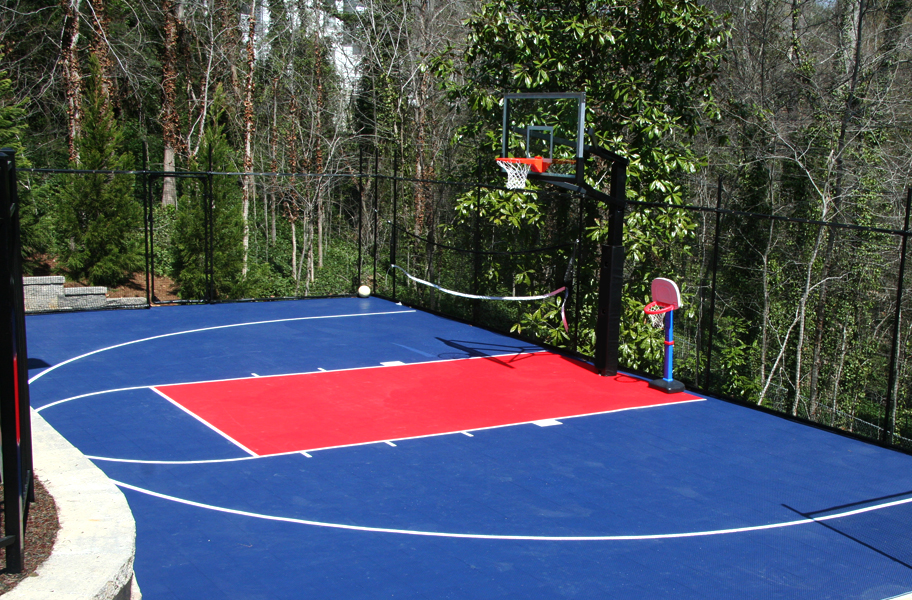
Outdoor basketball court tiles are interlocking polypropylene panels that snap together on top of a concrete or asphalt slab. Compared with bare pavement, they give a little under every landing, let rain drain straight through, and let you replace one damaged square instead of resurfacing the court. For a family court, that mix of comfort, drainage and easy repair is why a soft tile surface usually wins.
Key Takeaways
- A plastic basketball court is a floating layer of polypropylene tiles over a firm base. The slab underneath still matters.
- Surface hardness affects knees. A clinical review on the National Library of Medicine bookshelf cites jumper’s knee in 38% of athletes who play on concrete, versus 20% on other surfaces.
- Open grid tiles drain through the surface, so you are not waiting for puddles to evaporate.
- A 30 by 30 foot half court (900 square feet) is a common backyard size. HomeGuide puts installed prices at $4 to $16 per square foot.
- A damaged tile pops out and gets swapped in minutes. A paved court needs periodic resurfacing.
What Is a Plastic Basketball Court?
A plastic basketball court is a playing surface built from modular tiles, usually a high impact polypropylene blend. The tiles lock together at their edges and float on the base below. Nothing is glued down.
“Soft” is relative. The top stays firm enough for a consistent bounce, while the grid and joints give slightly when a player lands or cuts.
What the Tiles Are Made Of and How They Fit
- Material. Tile maker VersaCourt molds its outdoor tiles from high impact copolymer polypropylene with UV stabilizer and antioxidant additives to slow fading.
- Size. Its Game Outdoor tile measures 10 by 10 inches, so a 30 by 30 foot half court takes roughly 1,300 tiles.
- Grid top. An open grid lets rain fall through to the slab instead of sheeting across the court.
- Expansion joints. Spring style joints let neighboring tiles shift slightly side to side.
We install this type of modular basketball court through our sport tile court service. It can go on the slab you already have or on a new base our crew builds.
Outdoor Basketball Court Tiles vs Concrete vs Asphalt
Concrete and asphalt make excellent foundations. The trouble starts when the pavement is also the playing surface.
| Factor | Tiles over a slab | Concrete | Asphalt |
|---|---|---|---|
| Feel on landings | Slight give from grid and joints | Rigid, no give | Rigid, no give |
| Falls | Firm, molded plastic top | Hard, rough pavement | Hard, rough pavement |
| After rain | Drains down through the tiles | Runs off the top, low spots puddle | Runs off the top, low spots puddle |
| Cracks | Tiles bridge cracks up to 1/2 inch | Needs control joints | Cracks as it ages |
| Upkeep | Swap a damaged tile in minutes | Resurface every 8 to 15 years | Seal every 3 to 5 years, resurface every 5 to 15 |
The lesson: keep the slab and change what your feet touch. Tiles turn rigid pavement into an all weather outdoor basketball court that is easier to fix.
Why a Soft Outdoor Basketball Court Is Easier on Your Body
Knees and Joints
Basketball is a jumping sport, and jumping sports carry a high rate of patellar tendinopathy, better known as jumper’s knee. It shows up as pain at the bottom tip of the kneecap, brought on by repeated jumping and landing.
The ground under those landings matters. StatPearls, the clinical reference on the National Library of Medicine bookshelf, cites study results showing jumper’s knee in 38% of athletes who play on concrete, compared with 20% on other surfaces. It also says up to 14% of recreational jumping athletes have symptoms at some point.
Tile makers tackle this in two ways. VersaCourt says its outdoor tiles pair slight side to side play at the joints with a gentle vertical flex, which it credits with giving knees, lower backs and joints some forgiveness.
Falls and Scrapes
Kids fall, and bare pavement is unforgiving. The Consumer Product Safety Commission’s playground handbook says concrete, asphalt or other hard surfaces should never sit directly under playground equipment. The rule exists to prevent serious head injuries from falls.
Be realistic, though. The CPSC accepts mats and other unitary surfacing only when tested to the ASTM F1292 impact standard. Do not treat court tiles as a safe landing from the rim. They do swap rough pavement for a molded plastic face.
Tip: The NFHS court diagram suggests 10 feet of open space outside the boundary lines and no less than 3 feet. Extend the tiles past your lines so a player chasing a loose ball stays on the court surface, and pad the hoop pole.
Drying Out After Rain
Rain runs off the top of a concrete or asphalt court, and low spots hold it. The American Sports Builders Association calls these puddles birdbaths and says they delay play after rain. VersaCourt says its open grid tiles drain and dry quickly.
Heat on Sunny Afternoons
Dark pavement gets hot. In an Arizona pilot study cited by the U.S. Environmental Protection Agency, conventional paving such as asphalt reached surface temperatures up to 152°F at midday.
Tiles feel the sun too. The CPSC notes that dark surfacing in intense sun has blistered bare feet, so choose a light tile color or add shade.
What Base Do Outdoor Basketball Court Tiles Need?
Tiles need a solid, flat surface under them, so they cannot go straight onto a lawn or bare soil.
- New concrete. VersaCourt calls this its most highly recommended base. Its subsurface guide calls for at least 4 inches of 3,000 PSI concrete, steel reinforcement, a medium broom finish and a slope of 0.5 to 1 percent.
- Asphalt. It costs less up front, but hot mix asphalt is a flexible pavement that cracks over time. VersaCourt warns that it breaks down with repeated freeze and thaw cycles.
- Existing slab or driveway. Often usable as is. VersaCourt says its tiles can lie over structural cracks no wider than 1/2 inch, though only tiles rated for vehicles belong where cars park.
- Compacted stone. A crushed stone pad drains through and skips the concrete pour. It plays a bit softer, and VersaCourt prefers concrete for basketball. Our guide to courts built on a gravel base explains when stone suits a game court.
Weighing asphalt vs concrete for a new pad? HomeGuide puts asphalt at $3 to $7 per square foot and concrete at $5 to $10. Concrete costs more up front, and it is the base VersaCourt recommends.
Checklist Before Tiles Go on an Existing Slab
- Walk the slab after a rain and mark every spot where water stands.
- Measure crack widths. Anything wider than 1/2 inch gets repaired first.
- Plan the court 2 to 3 inches shorter than the slab in both length and width, as VersaCourt advises, so the tiles have room to expand.
- Mark the hoop location early. An in-ground system is anchored in its own footing, so read up on the elements of a quality basketball hoop before the tiles go down.
Outdoor Basketball Court Sizes and Costs
Size drives the budget, since most costs scale with square footage. HomeGuide notes that most home courts are smaller than regulation but should be at least 30 by 30 feet for 3 on 3 games and three point shots.
| Court | Size (feet) | Area (sq ft) | Installed range |
|---|---|---|---|
| Backyard half court | 30 by 30 | 900 | $3,600 to $14,400 |
| High school half court | 42 by 50 | 2,100 | $8,400 to $33,600 |
| NBA half court | 47 by 50 | 2,350 | $9,400 to $37,600 |
| High school full court | 84 by 50 | 4,200 | $16,800 to $67,200 |
| NBA full court | 94 by 50 | 4,700 | $18,800 to $75,200 |
Those HomeGuide cost ranges describe a paved court with a painted surface and one hoop. Tiles replace that paint. VersaCourt publishes average tile prices of $2,700 to $8,300 for a half court and $10,000 to $24,000 for a full court.
Those figures exclude the base, excavation, hoops and shipping. VersaCourt puts a new concrete slab at $4 to $10 per square foot nationally, before site prep. For turnkey ranges that include excavation, drainage and the base, see our Bergen County backyard court cost guide.
Custom Court Design Choices That Shape the Budget
- Court depth. The high school three point arc sits 19 feet 9 inches from the basket, so a court about 30 feet deep leaves room to shoot from behind it.
- Run off space. Tile past the lines adds area, so settle the buffer early.
- Extra games. Pickleball lines let one surface serve the whole family.
- Extras. HomeGuide prices a hoop at $150 to $2,000 installed and lists lighting, fencing and pole padding as separate costs.
Our residential court design team measures your yard, then recommends a layout that fits the space and the budget.
Upkeep: Swapping a Tile vs Resurfacing Pavement
Paved courts need periodic renewal. HomeGuide says an acrylic hard court typically needs resurfacing every 4 to 8 years. Its maintenance table lists concrete resurfacing every 8 to 15 years and asphalt every 5 to 15 as needed, plus asphalt sealing every 3 to 5.
A tile court handles damage one piece at a time. VersaCourt says a damaged tile lifts out with a hook and is replaced in minutes. Its tiles are also brittle tested to minus 25°F.
Routine care is light: blow off debris and hose the court down. For tile types and uses, see our complete guide to sports tiles.
Frequently Asked Questions About Outdoor Basketball Court Tiles
Is a plastic basketball court good for outdoor use?
Yes, as long as the tiles are made for outdoor play. Quality outdoor tiles are molded from polypropylene with UV stabilizers, use an open grid that drains rain, and include joints that allow for temperature swings. Tile makers sell separate indoor and outdoor lines, so confirm the rating. On a sound concrete or asphalt base, an outdoor plastic court handles sun, rain and snow.
What is the best surface for an outdoor basketball court?
For most homes, the best setup is a concrete slab topped with outdoor sport tiles. The concrete supplies a flat, stable platform, and the tiles add give, drainage and simple repairs. Asphalt costs less to pave but cracks as it ages. A painted concrete court plays well, but it stays rigid and needs resurfacing over the years.
Can you build a backyard basketball court without concrete?
Yes. Tiles can go over an existing asphalt driveway or patio that is in sound shape. A compacted crushed stone pad is another option for game courts, though it plays a bit softer. Tiles cannot sit directly on grass or bare soil, because they need a solid, flat surface. Concrete remains the base tile makers recommend most, especially where winters bring repeated freezing and thawing.
How long does a tile basketball court last?
HomeGuide’s court cost guide says a backyard sports court can last 15 to 25 years with proper care, and it advises keeping the court clean and repairing minor damage promptly. Tiles make those repairs simple, since a worn or cracked piece comes out on its own without redoing the whole court.
Are outdoor basketball court tiles slippery when wet?
Rain does not sit on them for long. An open grid lets water drain down through the court instead of pooling on top, and VersaCourt says its outdoor tiles drain and dry quickly. Any surface turns slick under wet leaves or grass clippings, so sweep after storms.
Build a Softer Outdoor Basketball Court at Home
My Backyard Sports designs and builds tile basketball courts, from backyard half courts to full courts, across New Jersey, New York, Connecticut, Austin and Houston. Our own crews handle the base, the tiles, the hoop and the line painting.