
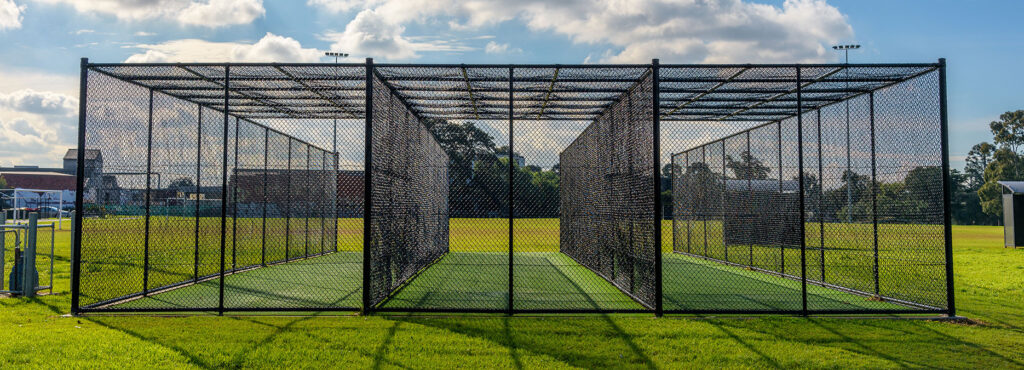
The main backyard batting cage pros and cons come down to reps versus room. A cage gives a hitter safe, daily swings at home with no balls to chase. The tradeoff is space and money: common home cages run 55 or 70 feet long, and the net, frame and ground surface each add cost. Size the length for the pitching distance your player is heading toward, not just this season’s.
Key Takeaways
- A 55 foot cage covers Little League’s 46 foot pitching distance and every Little League softball distance. Plan on 70 feet for 60 feet, 6 inches.
- The frame is bigger than the net. JUGS hangs its 70 foot net in a 74 foot frame.
- In-ground frames set in concrete footings, often 4 to 5 feet deep, handle wind best.
- A higher net number means thicker twine and a longer life. #36 nylon is a popular home choice.
- With a pitching machine running, hitters wear helmets and the feeder stands behind a screen.
What Is a Backyard Batting Cage?
A batting cage is a long net tunnel, hung from a frame or cables, that contains batted balls. Home cages range from pop-up tunnels to steel frames set in concrete. Common sizes are 12 or 14 feet wide, 12 feet tall and 55 or 70 feet long.
Backyard Batting Cage Pros and Cons at a Glance
Here are the backyard batting cage pros and cons for each part of the decision.
| Factor | Pro | Con |
|---|---|---|
| Practice time | Swings any day, no cage rental | Only as good as the practice plan |
| Safety | Net keeps balls off windows and people | Machines need helmets and a screen |
| Space | Doubles as a pitching and throwing lane | Long, flat strip of yard |
| Cost | Replaces paid cage sessions | Net, frame, surface and machine add up |
| Upkeep | Poly nets do not absorb water | Take nets down for high wind and snow |
| Approvals | Portable frames can move with you | Posts in concrete may need town or HOA review |
Buyers are noticing, too. Zillow’s 2026 home trends report found batting cages mentioned in 18% more for-sale listings than a year earlier. Cages also sit on our full list of sports we build for.
How Much Space Does a Backyard Batting Cage Need?
Start with the pitching distance your hitter sees in games. Under Little League’s field specifications, baseball players in the Major Division and below pitch from 46 feet. Junior and Senior League pitch from 60 feet, 6 inches.
Softball is shorter: 35 feet in the Minor League, 40 feet in the Majors and 43 feet for Junior and Senior League. See our guide to baseball diamond dimensions for the full field.
| Net size (L x W x H) | Best for | Pitching distances that fit |
|---|---|---|
| 35 x 12 x 12 ft | Tee, soft toss, short toss | None at full distance |
| 45 x 11 x 11 ft | Portable, no-dig tunnels | 35 ft softball |
| 55 x 12 x 12 ft or 55 x 14 x 12 ft | Youth baseball and softball | 35, 40, 43 and 46 ft |
| 70 x 12 x 12 ft or 70 x 14 x 12 ft | Teen and adult hitters | Everything up to 60 ft 6 in |
These sizes mirror the nets JUGS sells, which also come 16 feet tall. At baseball distances, a 55 or 70 foot net leaves about 9 feet to split between the catcher’s spot and the pitcher or machine.
Plan for the Frame, Not Just the Net
JUGS’s outdoor instructions keep the net at least 2 feet from every pole or hard surface, so balls cannot bounce back at anyone. That is why its 70 by 14 foot net hangs in a 74 foot frame with an 18 foot middle crossbar.
Tip: Before you buy, stake out the full frame footprint with string. Check the view from next door and look for sprinklers, trees and buried lines.
In-Ground vs Above-Ground Batting Cage Frames
In-Ground Frames
In-ground frames use steel posts set in concrete footings, typically 4 to 5 feet deep, according to Practice Sports’ frame comparison. They are the steadiest home setup and hold up in wind. The catch is permanence, plus concrete work and cure time. JUGS frames use galvanized steel uprights that slide into ground sleeves set in concrete.
Above-Ground and Portable Frames
Above-ground frames skip the digging. They bolt to a concrete slab or stand on weighted feet, and can be removed or relocated, which suits HOA lots and rentals. Wind resistance is very good, just a step below in-ground.
Lighter portable tunnels go further. JUGS sells an 11 by 11 by 45 foot backyard cage that needs no digging or cement.
Batting Cage Net Weight, Material and Mesh
Net “weight” really means twine gauge. As Practice Sports explains, the higher the number, the thicker the twine and the longer the net should last.
| Net | Typical use |
|---|---|
| #21 poly | Budget pick for Little League hitters |
| #36 poly | Occasional backyard use, about one to two seasons |
| #36 nylon | Homeowners and high school players |
| #42 poly | Home cages that need extra durability |
| #60 nylon | Commercial facilities; almost twice as thick as #36 |
Nylon vs Polyethylene
Polyethylene costs less and does not absorb water, which JUGS says suits wet or humid climates. It is stiffer than nylon, so ball friction wears through it faster.
Nylon flexes, absorbs impact and resists abrasion, but it soaks up water. Outdoor nylon is often latex dipped, which Practice Sports says typically adds 15 to 25% to the net price.
Mesh Size and How the Net Hangs
JUGS builds its nets with 1 3/4 inch mesh. How the net hangs matters just as much.
- Let it pool. JUGS recommends at least 18 inches of net on the ground so balls cannot slip out underneath.
- Do not stake it down. A net that cannot give wears out early.
- Allow a little sag. No more than 1 to 2 feet on the middle section, per JUGS.
What Surface Goes Under a Batting Cage?
Grass costs nothing up front, but it wears thin at the plate and where the pitcher or machine works. Synthetic turf over a compacted stone base stays playable all season. Practice Sports’ turf guide removes about 4 inches of topsoil, then builds a crushed stone base topped with 2 inches of fine screenings.
A bolt-down above-ground frame needs a concrete slab to anchor into. Our own crews handle base work and surfacing, so ground and cage get planned together.
Pitching Machines and Home Cage Safety
A machine throws repeatable pitches, but it needs an adult feeder and brings real hazards. The JUGS BP1 owner’s manual sets rules worth following in any home cage:
- Batters wear batting helmets at all times.
- The operator wears safety glasses and a batting helmet.
- A pitching screen stands in front of the machine to protect the operator.
- Only trained adults 18 or older run it.
- Pitch speed fits the batter’s age and skill, and the machine stays off in the rain.
Short cages make pitches play faster. JUGS notes that a 60 mph pitch from 42 feet gives about the reaction time of an 86 mph pitch from 60 feet, so turn the dial down as you move closer. For game limits such as pitch counts, see our Little League rules guide.
Permits, HOAs and Neighbors
A pop-up tunnel rarely raises questions. A permanent 12 foot tall cage with posts in concrete may be reviewed as a structure, so confirm HOA approval and permit needs first. Our article on when you need a permit for a backyard sports facility covers what usually triggers one.
Talk to the neighbors early. A tall net is hard to miss, and a metal bat is loud.
What Does a Home Batting Cage Cost?
A cage is a stack of separate parts, so there is no single price. These published list prices, checked in September 2026, exclude site work and installation.
| Part | List price | Seller |
|---|---|---|
| Net only, #27 to #96 twine | $595 to $2,545 | JUGS |
| Net only, #24 to #84 twine | $299 to $2,198 | Cimarron Sports |
| In-ground steel frame | $1,680 to $3,890 | JUGS |
| In-ground frame | From under $1,000 | Practice Sports |
| Above-ground frame | From about $5,000 | Practice Sports |
| Foam or light-ball machine | $395 to $529 | JUGS |
| Baseball pitching machine | $1,945 to $4,795 | JUGS |
| Protective screen | $495 to $795 | JUGS |
Add site prep, concrete, turf or a slab, delivery and labor. Cage length, twine gauge and frame type drive the biggest swings.
Frequently Asked Questions About Backyard Batting Cages
Do batting cages actually help hitters?
They help when the reps have a purpose. A cage lets a hitter repeat a swing far more often than team practice allows. The gains come from structured tee work, soft toss and machine rounds at a speed the player can handle. JUGS warns that pitches thrown too fast are counterproductive and dangerous.
Can you put a batting cage in a garage or basement?
Yes, if the room is long and tall enough. Indoor nets usually hang from three tensioned cables, and Practice Sports calls for at least 12 feet of ceiling height for a standard retractable setup. It also advises at least 1 foot between the net and walls, and 3 feet or more from light fixtures and windows.
Can you combine a batting cage and a sport court in one yard?
Yes, with planning. A cage can run along one side of a backyard sport court so both share one level, prepared area. Lay out both at the same time and settle drainage, lighting and fencing together, because the base under a court and cage is the hardest part to change once it is built.
Ready to Plan a Batting Cage at Home?
My Backyard Sports designs and builds backyard batting cages, sport courts and sports turf in New Jersey, New York including Long Island, Connecticut, Austin and Houston. We measure your yard, recommend a layout that fits your hitter, then build and install it.