
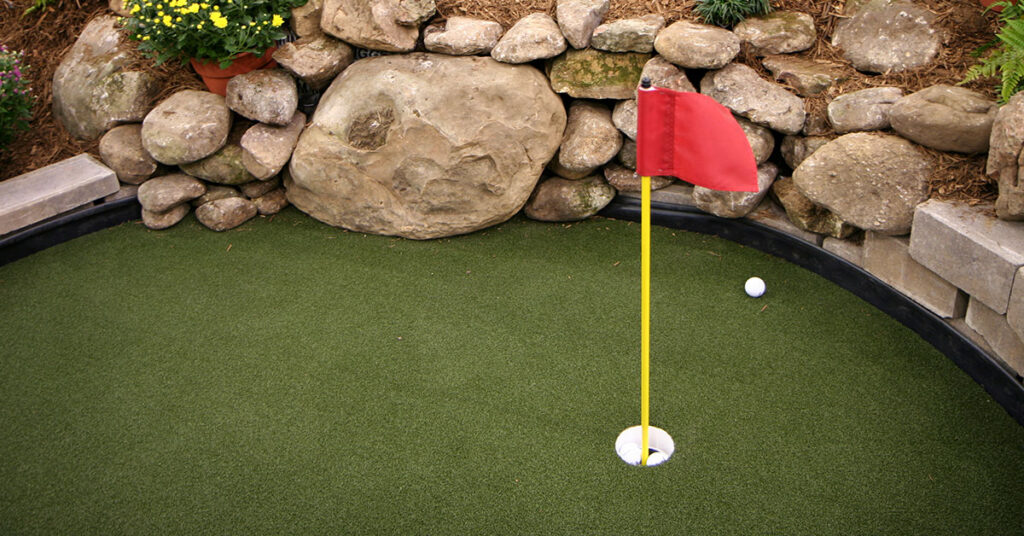
The synthetic vs real grass putting green choice comes down to upkeep, climate and patience. A real green done right is built like a golf course green, on 12 inches of lab-tested sand over gravel, and it needs mowing every day it grows. A synthetic green sits on compacted crushed gravel and swaps mowing, watering and fertilizer for regular cleaning and occasional brushing.
Key Takeaways
- The USGA method for golf greens calls for 12 inches of sand mix over at least 4 inches of gravel, with drain pipe below.
- Creeping bentgrass suits cool summers. Ultradwarf bermudagrass handles Southern heat but does poorly in shade.
- Grass greens are mowed every day of the growing season, to about 1/10 to 3/16 inch depending on the grass.
- A synthetic green goes on a compacted crushed gravel base, and most professional installs take 1 to 5 days.
- A seeded grass green needs at least three months of good growing weather before you putt on it.
Synthetic vs Real Grass Putting Green: Side by Side
Both greens aim for a smooth, firm surface that drains fast and rolls true. What goes underneath, and the weekly work after, is where they split.
| Factor | Real grass green | Synthetic green |
|---|---|---|
| Base | 12 in of sand mix over 4 in of gravel and drain pipe | Compacted crushed gravel that drains |
| Surface | Creeping bentgrass or ultradwarf bermudagrass | Nylon or polypropylene turf with infill |
| Mowing | Every day in season, about 1/10 to 3/16 in | None |
| Other upkeep | Irrigation, fertilizer, fungicide | Cleaning, brushing, infill top-ups |
| Green speed | Shifts with weather, growth and mowing | Holds its speed more consistently |
| Time to first putt | 3 or more months of growing weather | 1 to 5 days for most installs |
| Lifespan | Grass renews itself while care continues | 5 to 15 years, by materials and care |
Still deciding whether you want a green at all? Start with the pros and cons of a backyard putting green. This guide covers how each type gets built and kept.
How to Build a Real Grass Putting Green at Home
Many golf course greens are built to the USGA method, the industry standard since 1960. The USGA has revised it five times, most recently in 2018. A sand green built this way drains quickly and resists compaction.
Here is the profile from the USGA’s 1993 construction recommendations, with 2004 updates. The 2018 edition keeps the same root zone depth, gravel layer, sand rule and drainage minimum.
- Pick the sunniest spot. A USGA agronomist puts the need for bentgrass greens at eight or more hours of direct sun a day.
- Shape the subgrade. Dig and compact the native soil about 16 inches below the finished surface, following the same contours you want on top.
- Trench in drain pipe. Lay 4-inch pipe in trenches at least 8 inches deep, with side lines no more than 15 feet apart.
- Spread the gravel. Cover the whole subgrade with at least 4 inches of clean, washed gravel.
- Add the root zone. Spread 12 inches of lab-tested sand mix, blended off site. At least 60 percent of it must be medium or coarse sand, and it must drain at least 6 inches of water per hour.
- Plant at the right time. Late summer or early fall is best for bentgrass. Seeded then, it usually sprouts in five to seven days.
- Wait. Allow at least three months of good growing weather before play. Most greens seeded in fall open the following season.
Best Grass for a Home Putting Green in Your Climate
Creeping Bentgrass for Cooler Summers
Creeping bentgrass is a fine-textured, cool season grass. It spreads by stolons, so it heals from ball marks and foot traffic. NC State Extension also rates its upkeep as very high, with frequent fungicide sprays in summer.
Heat is its weak spot. Rutgers research published by the USGA links summer decline in bentgrass greens to high temperatures, and turf cut at 0.125 inch lost quality faster than turf cut at 0.156 inch.
Ultradwarf Bermudagrass for Southern Heat
Bermudagrass is a warm season grass with excellent heat and drought tolerance, but it struggles in shade. Ultradwarf varieties such as Champion, MiniVerde and TifEagle were bred and selected to handle very low mowing heights.
They go off color or dormant in winter, and many courses paint them. In Austin or Houston heat, an ultradwarf is usually the more practical grass for a sunny backyard green.
Daily Care of Natural Grass Putting Greens
A 1979 USGA Green Section article put it plainly: putting green grasses need close, frequent mowing every day of the growing season. That means a reel greens mower and someone to run it, including vacation weeks.
How Short Is a Putting Green Mowed?
- Bentgrass. Penn State Extension gives 5/32 to 3/16 inch (0.156 to 0.187) as the acceptable range.
- Ultradwarf bermudagrass. A 2008 USGA article reports that most top quality ultradwarf greens are cut at 0.105 to 0.125 inch.
The Rest of the Routine
Plan on sand topdressing, fertilizer, summer fungicide and a close eye on irrigation. A USGA agronomist lists skimpy topdressing as a common grow-in mistake, because thatch builds up and slows drainage.
Rolling helps too. Research the USGA summarized found that regular rolling lets you raise the mower up to 0.03 inch in summer heat and keep the same speed.
Tip: Grain matters on grass. Penn State measured as much as a 24 to 30 inch difference in ball roll putting with the grain versus against it.
How a Synthetic Putting Green Is Built
A synthetic green swaps the sand profile for a firm, compacted gravel base. Any slopes you want are graded in while the site is prepared.
- Prep the site. Clear away the sod, level uneven ground, fill any low spots and dig out the area the green will cover.
- Shape the breaks. Grade in the slopes you want, but keep the cup areas gentle. A USGA Green Section article rates slopes of 3 percent or more as too steep for a hole at a 10-foot green speed.
- Build the base. Fill the dug-out area with crushed gravel and compact it into a firm subbase that drains. HomeGuide recommends class 1 or 2 permeable base rock.
- Lay the turf. Install the nylon or polypropylene turf over the gravel base.
- Add infill. Spread infill, a granular material that sits between the turf fibers.
HomeGuide puts most professional installs at 1 to 5 days, while larger or more complex greens can take two weeks or more. For how fibers and infills keep improving, see recent advances in synthetic turf.
Which Green Rolls More Consistently?
Green speed is measured with a Stimpmeter, a 36-inch aluminum bar that came into wide use on U.S. courses in 1976 and 1977. You roll balls off it in opposite directions on a flat spot and average how far they travel, in feet.
Readings on American courses generally run 7 to 12 feet, according to a 2003 USGA Green Section article. The same piece warns that holding grass above 10 feet day after day usually brings turf problems.
A grass green’s pace moves with weather, growth and the mower. HomeAdvisor’s cost guide notes that synthetic turf holds its speed more consistently, with upkeep kept to a minimum.
Tip: Do not chase a number. Surveys cited by the USGA show most golfers cannot feel a speed change of six inches or less.
Cost and Lifespan: Where the Money Goes
HomeAdvisor’s backyard putting green cost guide puts installed greens at $15 to $40 per square foot, with the biggest greens costing the least per foot. Leveling a yard that is not smooth or properly sloped adds cost, and access so limited that big equipment cannot get in can double labor costs.
For a grass green, the money goes into tested sand, gravel, drain pipe, irrigation and a reel mower, then fertilizer and fungicide every season, plus your time.
For heat and water tradeoffs across the yard, see our turf vs grass comparison, and browse every sport surface we build if the green is part of a bigger plan.
Frequently Asked Questions About Synthetic vs Real Grass Putting Greens
What are golf greens made of?
Many modern golf greens are fine grass growing in a 12-inch root zone that is mostly sand. Under it sits at least 4 inches of gravel and a network of drain pipe, the USGA profile. Cool climate greens are often creeping bentgrass, sometimes mixed with annual bluegrass, while many Southern courses use ultradwarf bermudagrass.
What is the best grass for a home putting green?
Choose by climate and sun. Creeping bentgrass gives the classic surface where summers stay cool, but it needs frequent fungicide in hot weather. In Texas heat, an ultradwarf bermudagrass such as TifEagle or MiniVerde holds up better, as long as the spot gets full sun.
How long does a synthetic putting green last?
HomeAdvisor puts the life of an outdoor putting green at 5 to 15 years, depending on materials and upkeep. HomeGuide adds that turf made for golf greens outlasts ordinary landscape turf. Upkeep is light: cleaning, minor repairs and infill top-ups, which HomeGuide says average $250 to $550 a year.
Can I build a real grass putting green myself?
You can, but building it is the easy part. You need lab-tested sand, gravel, drainage and irrigation, then a reel mower and time to cut every day in season. If that sounds like a second job, a synthetic green is the simpler path, and small ones even come as DIY kits.
Plan Your Backyard Putting Green
My Backyard Sports designs and builds putting greens and sports turf in New Jersey, New York, Connecticut, Austin and Houston. We start by measuring your space and recommending a layout, and our own crews handle the base work.