
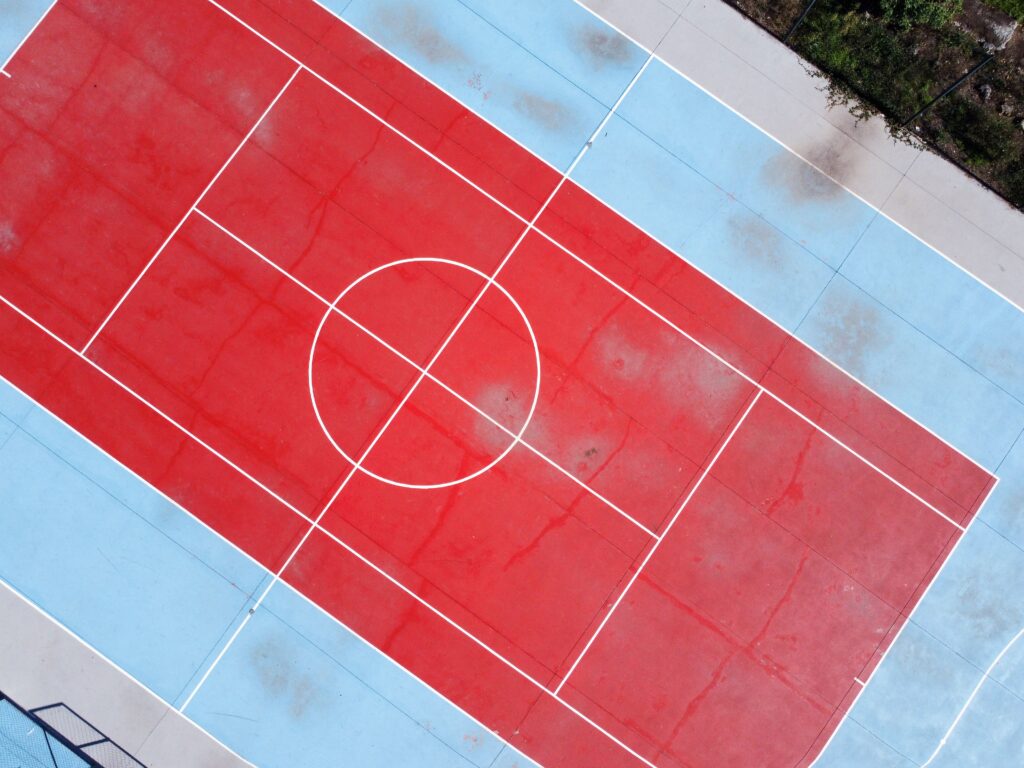
The history of sports tiles starts in 1964. That year, a French patent was filed for a modular floor covering for games and sports. In 1974, two American companies began selling modular court tiles. Later US patents added expansion joints for temperature swings and built-in sideways give. Today, FIBA sets approval tests for the floors used in elite outdoor 3×3 basketball.
Key Takeaways
- A French patent for a modular sports floor covering was filed in 1964, and a perforated plastic tennis surface won a US patent in 1969.
- Two American companies began selling modular court tiles in 1974.
- US patents granted in 1984 and 1990 tackled two problems: tiles that buckle when temperatures change fast, and stiff floors that often lead to sprained ankles.
- Today FIBA requires approved flooring for elite outdoor 3×3 basketball, and US pickleball play grew from 4.2 million players in 2020 to 24.3 million in 2025.
When Were Sports Tiles Invented?
The short answer: the idea was patented in the 1960s, and US companies have sold court tiles since 1974. No single person gets all the credit. A handful of inventors and two early companies shaped the modular court tile we know today.
The 1960s patents
Jean Becker and André Mennessier filed a French patent in October 1964 for a floor covering built from prefabricated, connected plates. It was meant for games and sports outdoors or under cover, and it was published in 1966.
Their US patent, filed in 1965 and granted in 1969, reads a lot like a modern spec sheet. It covers a molded plastic grid for tennis that stands on small feet, with open space making up 25 to 55 percent of the surface. The stated goals were drainage, durability and almost no maintenance, indoors or out.
The plastic behind it
The first patent came a decade after a breakthrough in plastics. Giulio Natta produced stereoregular polypropylene in 1954. He shared the 1963 Nobel Prize in Chemistry with Karl Ziegler for their polymer discoveries. By 1984, a US court tile patent called for a blend of rubber and polypropylene.
1974: two American starting points
In 1974, ten years after the French filing, two American companies began selling modular court tiles.
So who invented the modular court tile? No one person. The 1960s patent holders put the idea on paper. The two companies that started selling in 1974 sold tiles to American buyers, and later inventors kept refining the design.
History of Sports Tiles: A Timeline From 1954 to Today
Use this table as a quick reference. The dates come from patent records, governing bodies, a science history institute, a trade group and published company histories.
| Year | Milestone | Why it mattered |
|---|---|---|
| 1954 | Natta produces stereoregular polypropylene | A tough, moldable plastic arrives |
| 1964 | French patent for a modular sports floor covering | Earliest court tile patent in this list |
| 1969 | US patent granted for a perforated plastic tennis surface | Drainage and low upkeep lead the pitch |
| 1974 | Two American companies begin selling modular court tiles | A decade after the French filing |
| 1984 | US patent for a rubber and polypropylene tile with expansion joints | Tackles buckling from temperature swings |
| 1990 | Patent for tiles with built-in sideways give | Aimed at fewer sprained ankles |
| 2004 | VersaCourt brand founded | A newer brand enters the tile market |
| 2010 | 3×3 basketball’s first international event, Singapore Youth Olympics | 3×3 starts its international run |
| 2021 | 3×3 makes its Olympic debut at the Tokyo 2020 Games | 3×3 becomes an Olympic sport |
| 2025 | SFIA counts 24.3 million US pickleball players | Up from 4.2 million in 2020 |
| Today | FIBA’s current 3×3 rules require approved flooring outdoors | Tested for bounce, grip and shock absorption |
How Sports Tiles Changed From the 1980s to Today
1980s: tennis, basketball and temperature swings
Once tiles were on sale, inventors kept working on their weak spots. A 1984 US patent described tiles for tennis and basketball courts, indoors or out. It said they could go over old courts in need of repair, or on rooftops where normal construction will not work.
The same patent explained that a fast temperature change can make tiles buckle. Its fix was a pattern of floating expansion joints that gives the surface room to move.
1990: tiles with a little give
A 1990 US patent turned to the player. It described interlocking plastic tiles for athletic areas such as tennis and basketball courts, joined so each tile can shift slightly sideways.
The inventor’s case was simple. Conventional flooring meets sudden moves with stiff resistance that often leads to sprained ankles. Tiles with some give cushion those moves instead.
2010s to today: 3×3 and approved floors
Then 3×3 basketball arrived. FIBA says 3×3 was first played in international competition at the 2010 Youth Olympic Games in Singapore. It joined the Olympic program on June 9, 2017, and debuted at the Tokyo 2020 Games, held in summer 2021.
FIBA’s current equipment rules call for FIBA Approved 3×3 Flooring when games are played outdoors, on a playing area of about 49 by 36 feet (15 by 11 m). The same rules set a wear test for portable floors that are put together and taken apart.
Pickleball: The Newest Chapter in Sports Tile History
Pickleball has grown fast. The Sports and Fitness Industry Association counted 24.3 million American players in 2025, up from 4.2 million in 2020.
The game itself is nearly as old as the French tile patent. USA Pickleball’s history credits three dads, Joel Pritchard, Bill Bell and Barney McCallum, with starting it on Bainbridge Island, Washington, in the summer of 1965.
They began on an old badminton court with ping-pong paddles and a perforated plastic ball. Because the ball bounced well on the asphalt, they dropped the net from 60 inches to 36.
The first court built only for pickleball followed in 1967. A national amateur association formed in 1984, the year the first rulebook came out, and by 1990 the game was played in all 50 states.
For planning, the key number is the footprint. USA Pickleball sets the court at 20 by 44 feet for singles and doubles, with the net 36 inches high at the sidelines and 34 inches in the center.
At home, one tile surface can carry lines for more than one game, such as basketball and pickleball. Our own crews handle the base, the tiles, the hoops and the line painting on the sport tile courts we install.
What Sports Tile History Means for Your Court Today
Five decades of design choices still shape a tile court you might build this year. A few lessons carry straight over.
- The base still matters. Both the 1969 and 1984 patents set tiles on feet or pegs over a prepared base. The 1984 patent warns that pegs lifting off that base cause erratic ball bounce.
- Heat movement is old news. Inventors were designing expansion joints by the early 1980s, because fast temperature swings can make tiles buckle. Outdoor tiles need that room to move.
- Systems differ by maker. The patents in this story describe different tile designs, so ask whether matching replacement tiles will be easy to get later.
- Modular means fixable. VersaCourt, the tile system we install, says most damaged tiles can be replaced in minutes, so one bad tile does not mean redoing the court.
For the engineering side of the story, read how tile performance changed over the decades. If you are comparing surfaces, our sports tiles buyer’s guide covers indoor and outdoor types. You can also see why tiles beat bare concrete for outdoor basketball, or explore our full court design and construction services.
Frequently Asked Questions About the History of Sports Tiles
When were modular court tiles invented?
A French patent for a modular sports floor covering was filed in 1964, and a plastic tennis grid was patented in the United States in 1969. Two American companies began selling modular court tiles in 1974. Later US patents, granted in 1984 and 1990, added expansion joints for temperature swings and tiles with sideways give to cushion sudden moves.
Who invented the first interlocking sports tile?
No single inventor owns the idea. Jean Becker and André Mennessier filed a French patent for a modular sports floor covering in 1964, then won a US patent for a plastic tennis grid in 1969. Two American companies began selling court tiles in 1974, and later inventors patented improvements in 1984 and 1990.
Can sports tiles meet the rules for elite competition?
They can, if the product earns approval. FIBA’s catalog of approved outdoor 3×3 flooring includes interlocking modular tiles rated for elite play. Approved floors must meet set limits for bounce, grip and shock absorption, and portable ones must pass a wear test for being put together and taken apart. 3×3 has been an Olympic sport since the Tokyo 2020 Games, held in 2021.
Why were sports tiles invented?
The early patents spell out the goal. The 1969 US patent describes a flexible, permeable covering that does not deteriorate, needs almost no maintenance and works outdoors or under cover. Put simply, the inventors wanted a playing surface that let rain drain through, held up for years and needed little upkeep.
Bring Today’s Best Tile Surfaces to Your Backyard
My Backyard Sports designs and builds sport tile courts for homes, schools and clubs in New Jersey, New York, Connecticut, Austin and Houston. Tell us about your space and we will measure it and recommend a layout.