
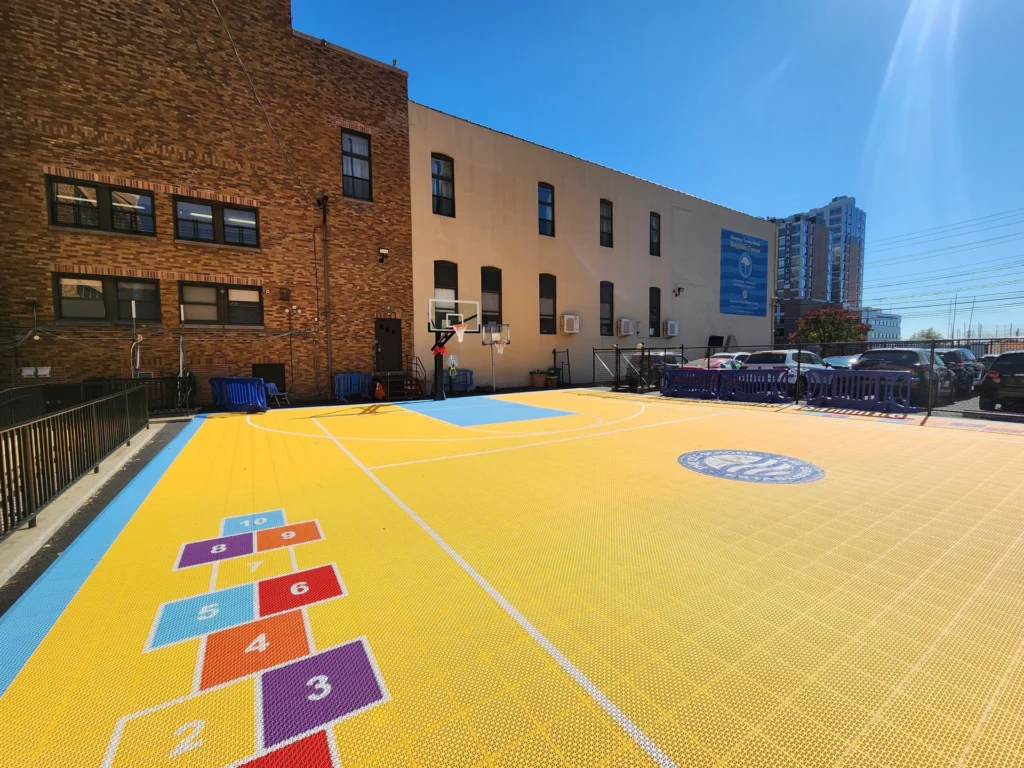
The idea behind modular sport court tiles is old: a US patent granted in 1969 described a perforated plastic tennis surface that let rain drain straight through. Today’s tiles are engineered to fix specific problems on the court. A good modern tile flexes a little under a landing, gives slightly on hard cuts, drains through an open grid, resists UV fading and delivers a steady ball bounce.
Key Takeaways
- Modern tile features target specific problems: slick footing, sore joints, puddles, fading, shifting rows, uneven bounce and noise.
- Cushioning comes two ways: vertical flex built into the tile and sideways give at the connectors.
- For outdoor courts, FIBA lists permeable polypropylene tiles about 0.4 to 0.8 inch (10 to 20 mm) thick, usually laid over a rubber or foam underlay.
- Tiles still need a flat, hard base. They follow the base under them, low spots and all.
- Ask for test data, not adjectives: rebound, traction, drainage rate and temperature range.
How Did Sport Tiles Go From Basic Flooring to Performance Surfaces?
The core idea has not changed. Interlocking pieces snap together over a hard base to make a playable court. What changed is how much engineering goes into each piece.
Early patents already chased goals that still matter, such as water that drains straight through and joints that cope with temperature swings. For the dated milestones, read our history of sports tiles.
The table below matches each common court problem to the tile feature built to solve it.
| Problem | What players feel | Modern fix |
|---|---|---|
| Grip | Slipping on stops, or shoes that grab too hard | Surface profiles tuned for traction |
| Impact | Jarring landings | Flexing support grids and cushioned underlays |
| Hard cuts | Stress on knees and joints | Connectors with slight side-to-side give |
| Water | Puddles and slow drying | Open grids that drain straight through |
| Sun | Faded, weakened plastic | UV stabilizer and antioxidant additives |
| Heat and cold | Rows that bulge or gap | Expansion room built into the joints |
| Bounce | Dead spots | Rebound tested and published by the maker |
| Noise | Plastic clatter | Perforated tops that dampen sound |
Grip: Traction That Holds Without Grabbing
Traction is a balancing act. Too little, and players slide on a hard stop. Too much, and the shoe sticks while the body keeps turning.
FIBA’s equipment rules handle this with a window, not a minimum. Floors for FIBA games must average 80 to 110 on a pendulum slip test, so too much grip fails just like too little. The rule is for indoor courts, but the same balance matters outside.
Tile makers build grip into the surface itself. VersaCourt’s spec for its Compete indoor tile calls for a tiny surface profile to reduce slipping and hide scuff marks.
Wet footing matters too. Surfaces approved by FIBA for outdoor 3×3 play have been tested for slip resistance in wet conditions.
Shock Absorption and Lateral Give: Why Newer Tiles Feel Softer
Vertical flex
A tile absorbs impact by flexing slightly as a player lands. VersaCourt says the slight vertical flex of its 3/4 inch Game outdoor tile reduces stress on aging joints and lower backs.
Underlays add more cushion. The FIBA outdoor courts guide says outdoor tiles usually sit on a rubber or foam underlay about 1.6 to 2 inches (40 to 50 mm) thick. In most cases, that underlay is needed to reach the elasticity FIBA requires for Level 1 competitions.
Sideways give
The second advance is sideways. Basketball and pickleball are full of hard stops and cuts, and a rigid slab gives nothing back.
VersaCourt, whose systems we install, uses spring tension expansion joints that let tiles shift slightly side to side. It says that small movement, plus a gentle vertical flex, gives players’ lower backs, knees and joints some forgiveness. To see how that compares with painted asphalt, read why soft outdoor basketball courts are gentler on players.
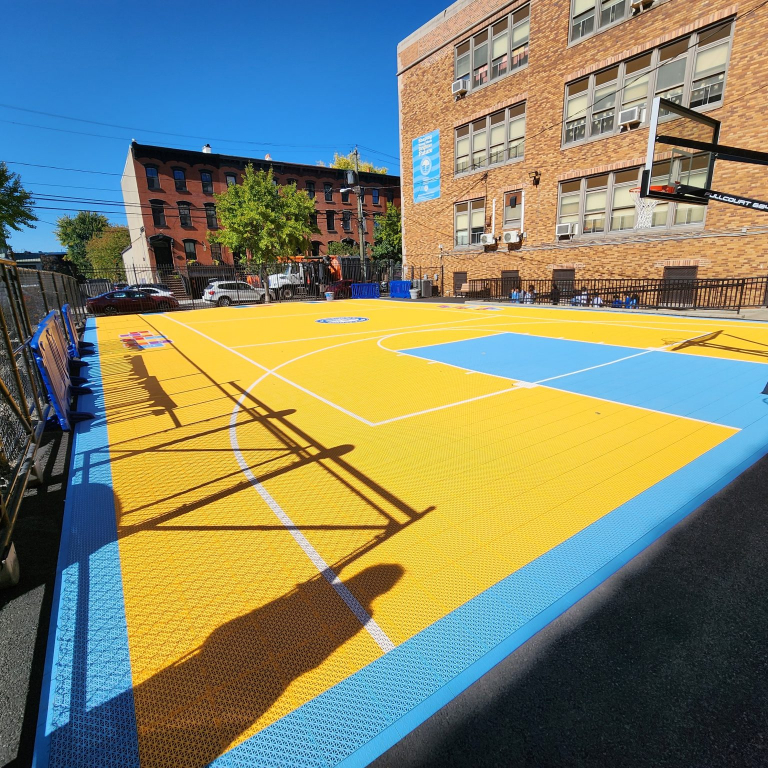
Drainage: How Tiles Shed Water So You Can Play Sooner
A painted slab has to shed rain off its surface. Perforated tiles let water drop straight through the open grid to the base below. VersaCourt says the open grid of its Game outdoor tile lets a court drain and dry quickly.
Drainage is measurable, so ask for the number. FIBA classes any approved 3×3 surface that passes less than about 5.9 inches (150 mm) of water per hour as impermeable.
Tiles do not fix a bad base. FIBA says a basketball floor must be perfectly flat, with no crowns, and allows a slight slope of up to 1 percent only where surface drainage is not otherwise possible. For a new concrete base under its tiles, VersaCourt specifies a slope of 0.5 to 1 percent.
Tip: If water ponds on your driveway or old court today, have the low spots corrected before tiles go down. Otherwise the puddle simply moves under the tiles.
UV, Heat and Cold: Engineering Tiles for Outdoor Life
Sun and color
Sunlight slowly breaks down outdoor plastic. VersaCourt blends UV stabilizer and antioxidant additives into its high impact polypropylene copolymer to guard against color fade and tile deterioration. Surfaces with FIBA’s Approved 3×3 status have also been tested for UV weathering.
Color affects heat as well. The EPA reports that asphalt can reach 152°F at midday, while cool pavements that reflect more solar energy stayed 10 to 16°F cooler in a Phoenix pilot. On an unshaded court, lighter tile colors are worth considering.
Expansion and contraction
Plastic grows in heat and shrinks in cold. VersaCourt’s spec for its Compete indoor tile lists a thermal expansion rate of 63 millionths of an inch, per inch, per degree Fahrenheit. At that rate, a 50-foot row would change length by roughly 2.3 inches over a 60 degree temperature swing.
Expansion joints are the answer. A 1984 US patent for a modular sports surface explains why they matter: a fast temperature change can make tiles buckle and cause an erratic bounce. Today, the Compete spec’s spring tension lock allows 0.05 inch of expansion between tiles. VersaCourt also advises making a court 2 to 3 inches shorter than its base in width and length.
VersaCourt lists temperature tolerances of minus 22°F to 248°F for its outdoor Active tile.
Ball Bounce and Noise: Making Plastic Play Like a Real Court
A court is only as good as its bounce, and some makers publish rebound data. VersaCourt’s specification for its Compete indoor tile reports 95.2 percent vertical rebound under the ASTM F2117 test.
For context, FIBA’s rules require indoor floors to reach at least 90 percent ball rebound under the European test EN 12235. Different test methods are not directly comparable, so compare products tested the same way.
On noise, the same spec says small perforation slits in the tile top dampen sound, and it lists a noise reduction coefficient of 20 percent under ASTM C423.
FIBA’s guide also names ball noise carrying into nearby buildings as something to minimize. If your court sits near a house or a neighbor, ask about sound before you order.
Modular Sport Court Tiles Buyer Checklist
Use this list when you compare quotes or product sheets. Ask for the numbers in writing.
- Material. High impact polypropylene copolymer with UV stabilizers and antioxidants blended in.
- Cushioning. A flexing support grid, an underlay option, or both.
- Lateral give. Connectors designed for slight side-to-side movement.
- Traction. A surface designed for grip, with wet and dry performance described.
- Drainage. An open grid and a published infiltration rate.
- Expansion. Expansion joints and a stated temperature range that fits your climate.
- Bounce. Vertical rebound results with the test method named.
- Noise. Sound-dampening tops if the court is near living space.
- Lines. Taped or painted game lines, and how often they need refreshing.
- Base. A flat, hard base such as concrete, asphalt or engineered crushed stone, checked for low spots before install.
- Warranty. Length and coverage in writing from the tile maker.
On upkeep, FIBA suggests lifting outdoor tiles once a year for a deep clean and refreshing court markings every three to five years.
My Backyard Sports installs modular sport tiles for home and commercial courts, and our own crews handle the base work, surfacing, hoops and line painting. Still weighing tiles against paint? Our sports tiles buyer guide covers the tradeoffs, and the backyard sport court cost guide helps with budgeting.
Frequently Asked Questions About Modular Sport Court Tiles
What are modular sport court tiles made of?
FIBA lists permeable polypropylene tiles about 0.4 to 0.8 inch (10 to 20 mm) thick as one surface option for outdoor courts. VersaCourt molds its tiles from a high impact polypropylene copolymer, with UV stabilizer and antioxidant additives to slow fading. A 1984 US patent for a sports tile proposed a rubber and polypropylene alloy, also with UV stabilizers, for outdoor use.
Are sport court tiles easier on your knees than concrete?
They are designed to be. Modern tiles flex slightly under a landing, and some connectors allow a little sideways give during cuts. FIBA notes that outdoor tiles usually need a rubber or foam underlay to reach the elasticity required for its Level 1 competitions. Bare concrete has no built-in cushioning.
Can you put sport court tiles on grass or dirt?
Not directly. Tiles need a flat, hard base because they follow every dip beneath them. VersaCourt lists concrete, asphalt, crushed stone and its own foundation panels as base options, and its stone base process includes removing the sod and compacting the ground. It does not recommend a stone base for pickleball or tennis.
How long do outdoor sport court tiles last?
FIBA’s outdoor courts guide gives permeable polypropylene tile flooring a standard lifespan of about 15 years, depending on usage and climate. It also warns that skipping regular cleaning shortens a court’s life. For the tile itself, VersaCourt advertises a lifetime warranty on its Game outdoor tile. Read each warranty’s terms before you buy.
Ready for a Modern Tile Court at Home?
My Backyard Sports designs and installs modular tile courts for basketball, pickleball and multi-sport play in New Jersey, New York, Connecticut, Austin and Houston. Tell us about your space, and we will measure it and recommend a layout.