
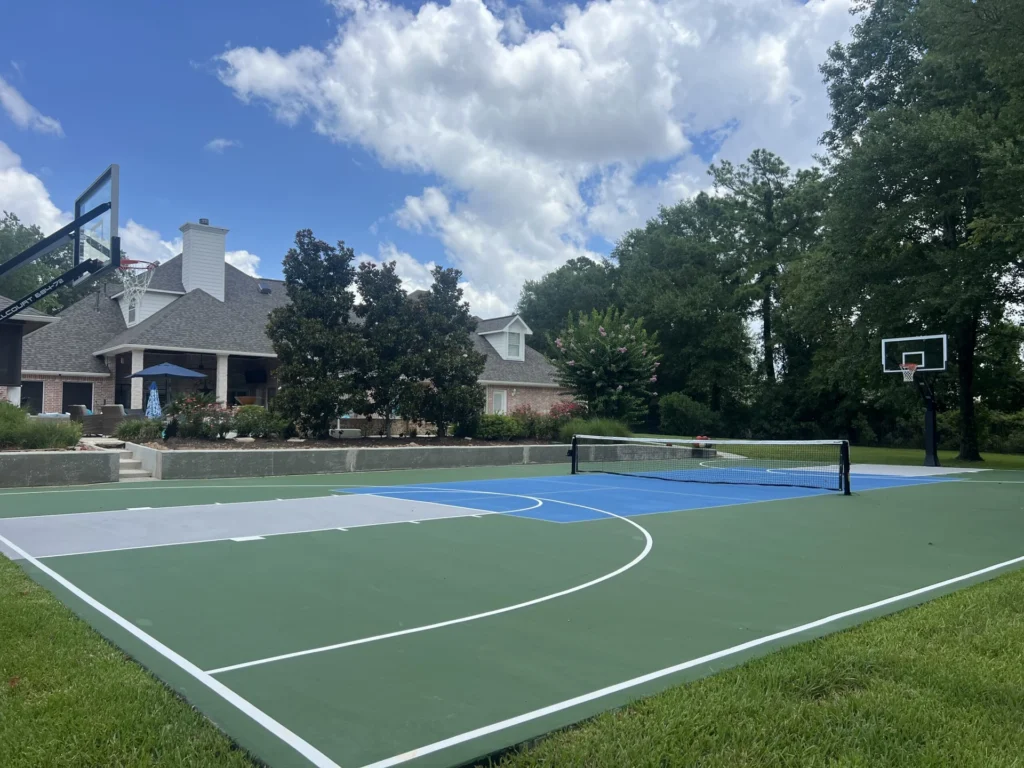
Sports tiles are interlocking plastic panels that snap together into a court over concrete, asphalt or a prepared stone base. VersaCourt’s published outdoor tile sizes, for example, run from 10 to about 16 inches square and 1/2 to 3/4 inch thick. Outdoor versions use UV-stabilized polypropylene with an open grid that drains rain. The surface usually goes down in a day, and a damaged tile swaps out on its own.
Key Takeaways
- Outdoor tiles have an open grid top that drains rain. Indoor tiles have a tighter face made to feel like a wood gym floor.
- The base decides how the court plays. VersaCourt calls for a flat, hard base, with new concrete sloped 0.5 to 1 percent.
- HomeGuide’s 2023 guide lists court tiles at $4 to $17 per square foot installed, not counting the slab underneath.
- Next to an acrylic coating, sports tiles win on cushion, drainage and spot repairs. Acrylic wins on odd shapes and easy color changes.
What Are Sports Tiles Made Of?
Outdoor sports tiles are molded from high-impact polypropylene copolymer. Makers blend in UV stabilizers and antioxidants to help the plastic and its color hold up in the sun.
Each tile hooks to its neighbors on all four sides and rests on a raised support structure. That suspended design flexes gently underfoot, and the grid top lets water fall through to the slab.
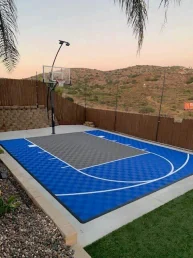
Here is how two VersaCourt outdoor tiles compare. VersaCourt is the tile system we install, and our sport tile court installation page covers color, line and logo options.
| Spec | Game Outdoor | Active |
|---|---|---|
| Tile size | 10 by 10 in | 15.75 by 15.75 in |
| Thickness | 0.75 in | 0.63 in |
| Top surface | Open grid | Open profile with drain channels |
| Locking | Six points per side | 24 connectors |
| Weight | Not listed | About 1.3 lb per tile |
| Standard colors | 17 | 10 |
| Built for | Outdoor multi-sport play | Driveways, parking areas and volleyball |
Indoor vs Outdoor Tiles
Indoor tiles swap the open grid for a flatter, tighter face. VersaCourt’s Compete indoor tile uses small star perforations to help dampen sound, and its Wood-Grain line has a realistic wood look.
Some tiles are rated for both settings, such as VersaCourt’s 1/2 inch Boost tile. For an uncovered yard, choose a tile its maker rates for outdoor use.
Which Sports Can You Play on Sports Court Tiles?
- Basketball. VersaCourt lists it for every one of its tile lines.
- Pickleball, tennis and padel. VersaCourt’s Pickleball Performance tile is built for these, and the maker wants concrete, not stone, underneath.
- Volleyball, futsal and badminton. VersaCourt lists each one for at least one of its outdoor tiles.
- Roller and inline hockey. Smooth-top tiles such as VersaCourt Boost let pucks glide without waxing.
- Shuffleboard. VersaCourt pitches tiles as a low-maintenance alternative to stained concrete.
If basketball is your main sport, read why we favor a soft outdoor basketball court over bare concrete.
Sports Tiles vs Acrylic Coated Concrete or Asphalt
Acrylic is the textured, colored coating on a traditional hard court. The ITF’s surface type definitions say it normally forms only the top few millimeters of a court, laid over a base such as concrete or asphalt.
| Factor | Tiles | Acrylic coating |
|---|---|---|
| Thickness | About 1/2 to 3/4 in of plastic | A few millimeters |
| Cushion | Gentle flex from the raised tile design | Firm unless a cushion layer is added |
| Rain | Drains through the tile | Runs off by slope |
| Install | Tile surface usually laid in a day | Several coats applied on site |
| Repairs | Swap one tile | Patch, then recoat |
| Renewal | No surface recoating | Resurface every 4 to 8 years |
| Color change | Buy new tiles | Change colors at resurfacing |
VersaCourt credits the cushion to the gentle vertical flex of its raised tiles. HomeGuide supplies the resurfacing interval.
Where Tiles Come Out Ahead
- Impact. The suspended surface flexes slightly and absorbs some shock that bare concrete does not.
- Old courts. VersaCourt can be laid over structural cracks up to 1/2 inch wide, so a worn slab can often stay.
- No curing. VersaCourt paints game lines at the factory, so no coating has to cure on site.
- Repairs. A damaged tile pops out with a hook or screwdriver in minutes.
Where Acrylic Comes Out Ahead
- Odd shapes. Square tiles must be cut to follow curves and angles, which adds labor and scrap.
- Style changes. New court colors mean new tiles, while acrylic just gets recoated.
What Goes Under Sports Tiles?
Sports tiles float on the base and copy every dip below them. Plan the base before you pick colors.
| Base | Best for | What to know |
|---|---|---|
| New concrete slab | Every sport, including pickleball and tennis | At least 4 in thick, 3,000 psi, reinforced, broom finish |
| Asphalt | Lower upfront cost | Cracks sooner and has a shorter life than concrete |
| Existing slab | Covering a tired court or patio | Must be solid and flat; round off sharp cracks |
| Compacted stone | Tight budgets or coverage limits | Softer bounce; VersaCourt’s FAQs advise against it |
VersaCourt’s subsurface preparation guide asks for a flat, hard base. New concrete should slope 0.5 to 1 percent, or roughly 1/16 to 1/8 inch of fall per foot.
Its stone option starts with geotextile fabric and 2 to 3 inches of compacted 3/4 inch minus crusher run. Then come 1 to 2 inches of 1/4 inch minus screenings and a rubber mat under the tiles.
VersaCourt says cost, ordinances or permeable surface limits can push buyers toward stone. Ask your town how it counts a stone base, then read about permeable sports courts or our gravel base sports courts in Bergen County.
Tip: Tiles expand and contract with temperature. VersaCourt sizes the court 2 to 3 inches shorter than the base each way and trims tiles at least 1/2 inch from posts.
How Sports Court Tiles Are Installed
- Measure the space and plan the layout, hoop and game lines.
- Build or repair the base, then sweep it clean and let it dry.
- Lay tiles from one corner, following the factory’s numbered plan if there is one.
- Lock each seam by stepping gently along it. Forcing the connectors can damage them.
- Trim edges and cut around posts with a table saw, a fine-tooth circular saw blade or a utility knife.
- On small, busy basketball courts, screw down the side opposite the hoop with concrete screws.
- Snap on edge ramps and corners, then paint lines if the factory did not.
VersaCourt says the tile surface almost always goes down within one day. The base, permits and weather take most of the schedule. If lines are painted on site instead of at the factory, ask how long the paint must cure before play.
Maintenance and Lifespan of Outdoor Sport Tiles
- Clear debris. Blow off leaves, sticks and grass clippings before they pile up.
- Wash gently. Use a pressure washer on a low setting and keep the spray off painted lines.
- Clean underneath. When dirt fills the grid, unsnap large sections, slide them aside and clean the slab.
- Keep heat away. Keep grills, fireworks and cigarettes off the court, and never rest a hot leaf blower on the tiles.
VersaCourt brittle-tests its outdoor tile to minus 25°F and says it resists rain, snow and ice, though some color loss is normal.
VersaCourt lists a 25 to 30 year structural life expectancy for its tiles. Its warranty replaces tiles with material or workmanship defects free for 5 years, then at a discount. It does not cover labor, improper installation or acts of God.
Sports Tile Flooring Cost: Published Ranges
Both guides below are a few years old, so treat them as a starting point.
| Item | Range | Source |
|---|---|---|
| Court tiles, installed, base extra | $4 to $17 | HomeGuide (2023) |
| Resilient court tiles, installed | $8 to $14 | Fixr (2022) |
| Concrete base | $5 to $10 | HomeGuide (2023) |
| Asphalt base | $3 to $7 | HomeGuide (2023) |
| Tennis court resurfacing, for comparison | $0.55 to $1.50 | HomeGuide (2023) |
A 30 by 30 foot half court is 900 square feet. At HomeGuide’s per square foot ranges, tiles alone work out to $3,600 to $15,300, and a new concrete slab adds $4,500 to $9,000.
Hoops, fencing, lighting and site work are extra. For local numbers, see our Bergen County backyard court cost guide.
Frequently Asked Questions About Sports Tiles
Can sports tiles go over an existing concrete slab?
Usually, yes, if the slab is solid and flat. VersaCourt says many of its courts go over existing slabs and driveways, so base prep is often limited. Its tiles can cover structural cracks up to 1/2 inch wide once sharp edges are rounded. A slab that is heaving, sinking or broken through needs repair first, because tiles follow the shape beneath them.
Are tile courts good for pickleball?
They can be, if the tile is designed for it. VersaCourt makes a Pickleball Performance tile and recommends a 4 inch concrete base with #5 rebar for the best ball bounce. It does not recommend compacted stone under pickleball or tennis. Ask your builder which tile they plan to use and why.
How much do sports court tiles cost per square foot?
HomeGuide’s 2023 guide puts court tiles at $4 to $17 per square foot installed, depending on the brand. Fixr’s 2022 basketball court cost guide lists $8 to $14 for resilient court tiles. HomeGuide’s figure leaves out the base, which it prices at $5 to $10 per square foot for concrete or $3 to $7 for asphalt.
Do tile courts need to be glued or anchored down?
Glue is not part of the install steps VersaCourt publishes. Tiles lock to each other and are sized with room to expand and contract with temperature. Busy basketball courts of about 30 by 30 feet or less can creep toward the hoop, so VersaCourt screws down the edge opposite the goal, hidden under the ramps.
Ready for a Sport Tile Court?
My Backyard Sports measures your space, recommends a layout and builds the base, tile surface, hoops and game lines with our own crews. We serve New Jersey, New York, Connecticut, Austin and Houston.