
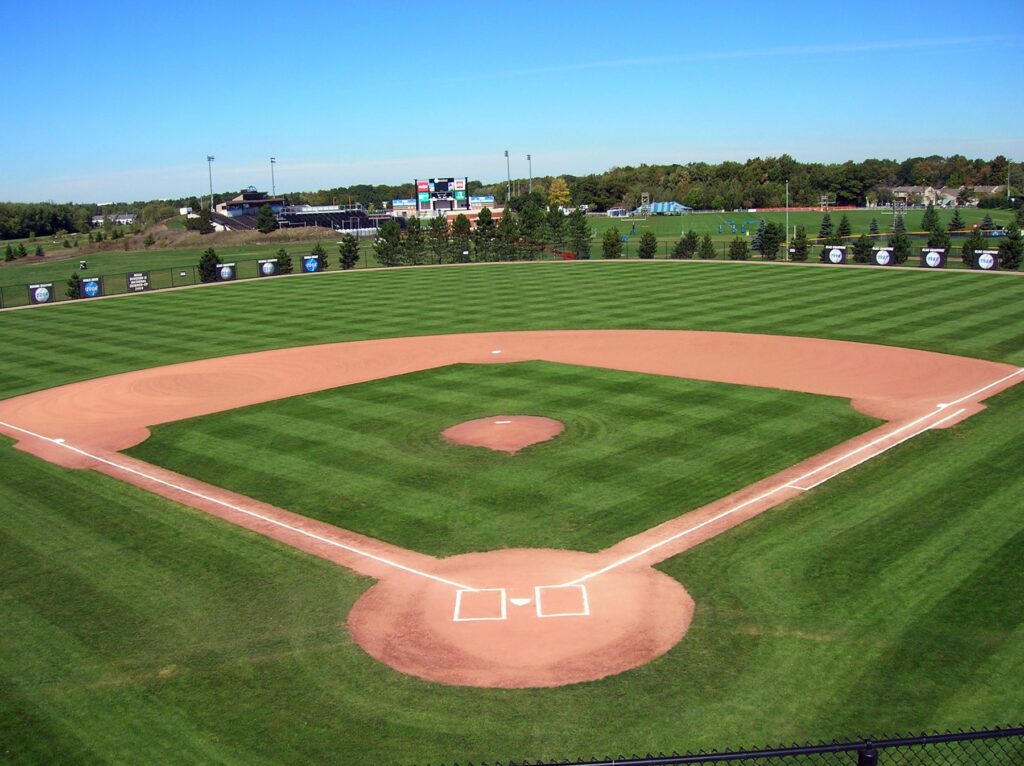
Regulation baseball diamond dimensions start with a 90 foot square. The bases sit 90 feet apart, the front of the pitcher’s rubber is 60 feet 6 inches from the back tip of home plate, and home plate to second base measures 127 feet 3 3/8 inches. Little League Minor and Major divisions use a 60 foot square with a 46 foot pitching distance.
Key Takeaways
- High school, college and pro infields are 90 foot squares, so home to second and first to third both measure 127 feet 3 3/8 inches.
- Every layout measurement starts at the back point of home plate, where the two foul lines meet.
- MLB bases grew from 15 to 18 inches square in 2023. High school bases are 15 inches, but first base must be an 18 inch or double base from 2027.
- Little League Majors play on 60 foot base paths with a 46 foot pitching distance and a recommended 200 foot fence.
- Measure both diagonals when you lay out a baseball diamond. If they match, your square is true.
Baseball Diamond Dimensions at a Glance
The pro figures come from Rule 2 of the 2026 MLB Official Baseball Rules. High school and college fields use the same 90 foot infield.
- Baseline: 90 feet.
- Home plate to center of second base: 127 feet 3 3/8 inches.
- First base to third base: 127 feet 3 3/8 inches.
- Pitching distance: 60 feet 6 inches.
- Pitcher’s mound: 18 foot circle, rubber 10 inches above home plate.
- Pitcher’s plate: 24 by 6 inches.
- Home plate: 17 inches across the front edge.
- Bases: 18 inches square in MLB, 15 inches in high school (first base changes in 2027).
- Infield dirt arc: 95 foot radius from the center of the rubber.
- Backstop: 60 feet or more behind home plate, recommended.
- Foul lines: 325 feet minimum on pro fields built after June 1, 1958.
- Center field: 400 feet minimum on those same pro fields.
How Far Is It From Home Plate to Second Base?
On a 90 foot baseball diamond, home plate to second base is 127 feet 3 3/8 inches. Measure from the back point of home plate to the center of second base, since that bag is centered on its corner of the square.
First base to third base is the same distance, which makes it your best accuracy check.
Home plate to first base
Home plate to first base is 90 feet on a regulation field and 60 feet on a Little League Majors field. Measure to the back outside corner of the bag, because first and third base bags sit entirely inside the square.
| Base path | Home to second base | Where it is used |
|---|---|---|
| 50 feet | 70 feet 8 1/2 inches | Tee Ball option |
| 60 feet | 84 feet 10 1/4 inches | Little League Majors and younger |
| 70 feet | About 99 feet | Intermediate 50/70 |
| 75 feet | 106 feet 3/4 inch | Junior League local option |
| 90 feet | 127 feet 3 3/8 inches | Junior and Senior League, high school, college, pro |
Base Dimensions, Home Plate and the Pitcher’s Rubber
Here are the bag, plate and rubber sizes by level.
| Item | MLB | High school | Little League Majors |
|---|---|---|---|
| Bases | 18 in square, 3 to 5 in thick | 15 in square, 2 to 5 in thick | 14 to 15 in square, up to 2 1/4 in thick |
| Home plate | 17 in front edge, 8 1/2 in sides, 12 in angled edges | Same as MLB | 17 in square with two corners cut |
| Pitcher’s plate | 24 by 6 in | 24 by 6 in | 18 by 4 in |
| Mound height | 10 in | 10 in | 6 in |
Why MLB bases got bigger in 2023
MLB moved from 15 inch to 18 inch bases in 2023. The league’s base size rule explainer says the main goal was more room for players and fewer collisions, especially at first base.
The larger bags trim 4 1/2 inches off the gap between first and second and between second and third. The 90 foot square itself did not change.
High school first base changes in 2027
Under NFHS rules, high school bases are 15 inches square. Starting in 2027, first base must be either a double first base or a single 18 inch bag, the NFHS announced in July 2026. Second and third stay at 15 inches.
Parts of a Baseball Field
Here is what you will mark or build on a regulation field.
- Infield. The square formed by home plate and the three bases. Rulebook diagrams add a dirt arc behind the bases, ending at the grass line.
- Pitcher’s mound. An 18 foot circle centered 59 feet from the back of home plate. The front edge of the rubber sits 18 inches behind center.
- Batter’s boxes. Two 4 by 6 foot rectangles, one on each side of home plate.
- Catcher’s box. A 43 inch by 8 foot area behind home plate.
- Running lane. A 3 foot lane along the last half of the path to first, just outside the foul line.
- On-deck circles. 5 foot circles, 37 feet from home plate when space allows.
- Coach’s boxes. Marked boxes in foul territory near first and third base.
- Foul lines and poles. The base lines extended to the fence. The lines themselves are fair territory.
- Warning track. A dirt strip along the outfield fence that warns fielders the wall is close.
Outfield Fence Distances by Level
MLB’s absolute floor is 250 feet to the nearest fence in fair territory, but its preferred distances run far deeper.
| Level | Down the foul lines | Center field |
|---|---|---|
| Pro field built after June 1, 1958 | 325 ft minimum | 400 ft minimum |
| MLB preferred, other fields | 320 ft or more | 400 ft or more |
| New high school field | 300 ft or more | 350 ft or more |
| Little League Junior and Senior | 300 ft recommended | 300 ft recommended |
| Little League 50/70 and Majors | 200 ft recommended | 200 ft recommended |
Little League and Youth Baseball Field Dimensions
Little League lists field sizes by division on its official field specifications page. Local leagues can shorten some distances for regular season play, so check with yours first.
| Division | Base paths | Pitching distance | Mound height |
|---|---|---|---|
| Minor and Major | 60 ft | 46 ft | 6 in |
| Intermediate 50/70 | 70 ft | 50 ft | 8 in |
| Junior League | 90 ft (75 ft local option) | 60 ft 6 in (54 ft option) | 10 in |
| Senior League | 90 ft | 60 ft 6 in | 10 in |
Tee Ball leagues may use a 50 foot baseball diamond, and Little League softball uses 60 foot base paths in every division. Little League’s Major and Minor layout recommends 25 feet from home plate to the backstop.
For pitch counts, age groups and game rules, see our guide to Little League rules and regulations.
Converting a 60 foot field for 50/70 play
Little League’s conversion guide extends the skinned infield to an arc 69 feet from the back of the pitcher’s plate. The 10 foot mound grows to a 12 foot circle with a second rubber at 50 feet.
A second set of disengaging bases goes in at 70 feet. A shared field should keep its fence between 200 and 275 feet from home plate.
How to Measure a Baseball Diamond Step by Step
You need two long steel tapes, stakes, string, marking paint and a helper.
- Pick the direction. MLB rules favor an east-northeast line from home plate through the mound to second base. Use it if your site allows.
- Set home plate. Stake the back point of home plate. Every measurement starts here.
- Find second base. Pull a tape 127 feet 3 3/8 inches toward center field and stake the center of second. Use 84 feet 10 1/4 inches on a 60 foot field.
- Find first base. Hook one tape at home and one at second. Pull 90 feet on each (60 on a Little League field) toward the right side and stake where they cross.
- Find third base. Repeat on the left side.
- Check the square. First base to third base should equal home to second. If not, reset first and third.
- Set the pitcher’s plate. On the home to second line, measure 60 feet 6 inches from the back of home plate to the front of the rubber (46 feet for Little League Majors).
- Run the foul lines. Stretch string from home past first and third to the fence. Foul poles go where the lines meet it.
- Mark the boxes. Lay out batter’s boxes, catcher’s box, running lane, coach’s boxes and on-deck circles from the rulebook diagram.
- Grade, then re-check. Base lines and home plate should be level with each other. Measure every stake again after grading.
Tip: At first and third, set the outside corner of the bag on your stake so the bag sits inside the square. At second base, center the bag on the stake.
How Much Space Does a Baseball Field Need?
Quarter circle math shows a 200 foot Little League fence encloses about 31,400 square feet of fair territory, roughly 0.7 acre, before foul ground and the backstop.
At the 300 foot Junior and Senior League distance, fair territory grows to about 70,700 square feet, around 1.6 acres.
Few backyards have that room. A batting cage fits daily hitting practice into a narrow strip of yard. Our guide to the pros and cons of backyard batting cages covers sizing, netting and surfaces. If your players also play softball, the differences between softball and baseball include a smaller field.
Schools, camps and parks can explore our sports construction services for cages, turf and courts beside an existing baseball diamond.
Frequently Asked Questions About Baseball Diamond Dimensions
How far is it from home plate to first base?
Home plate to first base is 90 feet on high school, college and professional fields. Little League Majors and younger divisions use 60 feet, and Intermediate 50/70 uses 70 feet. Measure from the back point of home plate to the back outside corner of first base.
What are the dimensions of a baseball base?
MLB bases are 18 inches square and 3 to 5 inches thick, a size adopted in 2023. High school bases are 15 inches square and 2 to 5 inches thick, and from 2027 first base must be an 18 inch or double bag. Little League bags are 14 to 15 inches square, no more than 2 1/4 inches thick at the outer edges, and must disengage from their anchors.
How far is it from first base to third base?
On a 90 foot baseball diamond, first base to third base is 127 feet 3 3/8 inches, the same as home plate to second base. Both are diagonals of the infield square. On a 60 foot Little League field the diagonal is about 84 feet 10 1/4 inches.
How big is a Little League baseball diamond?
A Little League Majors diamond is a 60 foot square with a 46 foot pitching distance to an 18 by 4 inch rubber set 6 inches above home plate. Home to second is about 84 feet 10 1/4 inches. Little League recommends a fence 200 feet or more from home plate.
How high is a pitcher’s mound?
On high school and pro fields, the pitcher’s plate sits 10 inches above home plate. The slope drops 1 inch per foot for 6 feet, starting 6 inches in front of the rubber. Little League uses 6 inches for Majors and younger, 8 inches for 50/70, and 10 inches for Junior and Senior League.
Want a Place to Practice Between Games?
My Backyard Sports designs and builds batting cages, sports turf and multi-sport courts for homes, schools and camps in New Jersey, New York, Connecticut, Austin and Houston. Tell us about your space, and our team will measure it and recommend a layout.