
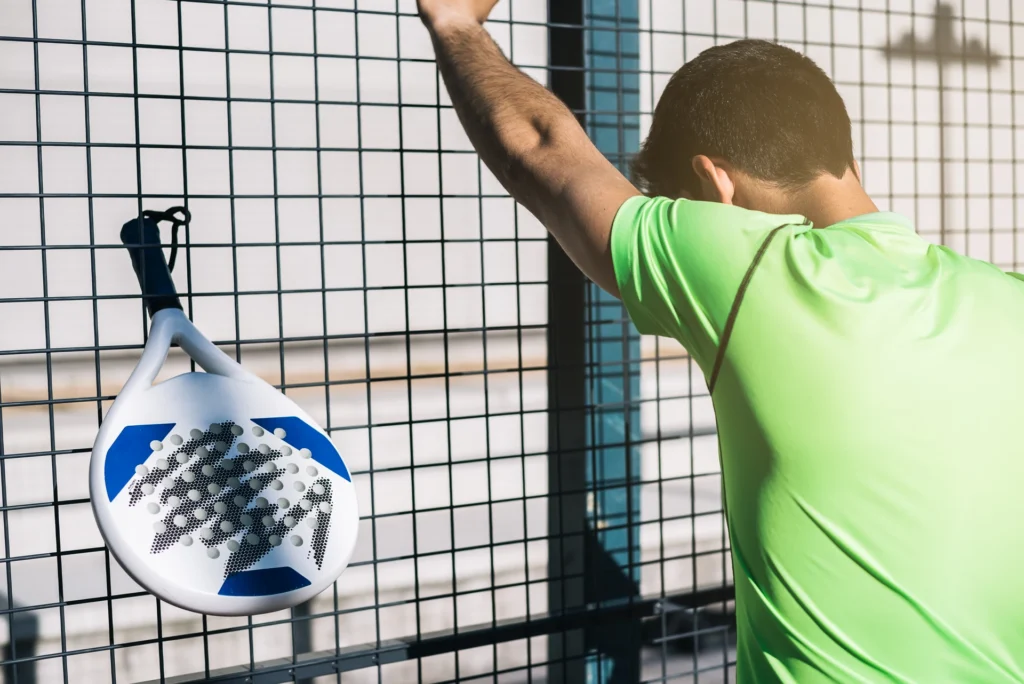
Why is padel a great sport? The main benefits of playing padel are a short learning curve, a real cardio workout and a game built for four friends. Serves are struck at or below the waist after a bounce, the walls keep the ball in play, and research on regular players links the sport to better fitness.
Key Takeaways
- Padel is easy to start: the serve is bounced and hit at or below the waist, and the walls give you second chances.
- In a 2025 study, average heart rate in padel was close to tennis doubles while players covered about 18% less ground.
- Racquet sports were linked to a 47% lower risk of death in a large British study that did not track padel.
- The elbow is the most common padel injury site, so learn good technique and add playing time gradually.
- A regulation court is about 66 by 33 feet (20 by 10 m) inside an enclosure up to about 13 feet (4 m) high.
Why Is Padel a Great Sport? It Starts With the Rules
Padel is a racquet sport played in pairs inside an enclosed court. It keeps the familiar tennis scoring but adds two twists: walls that stay in play and a serve with no overhead motion.
The International Padel Federation rulebook includes several rules that make padel friendly to new players.
| Rule | What it says | Why it helps |
|---|---|---|
| Serve | Bounce, then strike at or below the waist; two attempts | No overhead serve to master |
| Walls | Ball stays live after it bounces and hits a wall | A second chance on balls that get past you |
| Racket | Perforated face, 17.9 in (45.5 cm) max length | Short and stringless, nothing to restring |
| Scoring | 15, 30, 40, game; sets to six games | Familiar if you know tennis |
| Players | One pair on each side of the net | You always have a partner covering court |
For the backstory, read about the rise of padel, or see our padel vs pickleball comparison for court sizes and rules.
Benefits of Playing Padel: Easy Serve, Long Rallies, Teamwork
A Simple Serve Makes It Easy to Start
There is no overhead serve to learn. You stand behind the service line, bounce the ball and hit it diagonally over the net at waist height or lower.
The racket is short and has no strings. Researchers writing in Science & Sports in 2018 noted that padel does not demand high technical skill to start, and that its longer points add to the enjoyment.
The Walls Keep Points Alive
Once the ball bounces on your side, it stays live after it strikes the back or side walls. You can let it rebound and play it on the way out, or even hit it into your own wall to send it over.
In a 2025 study in Frontiers in Sports and Active Living, eight national-level male players played simulated 40-minute doubles matches of each sport. Padel produced about 92 rallies to 67 for tennis, and each padel rally lasted longer (6.5 seconds versus 4.9).
Strategy Beats Raw Power
Hitting harder is not always the answer, since a ball off the back wall can be played again. The same study counted about 20 lobs per padel match against fewer than 3 in tennis, plus far more volleys.
So padel rewards patience and teamwork: move together, lob opponents off the net and wait for a ball you can finish.
It Is Built for Four Players
The rules are written around pairs, and each pair hits the ball in turn. That makes it easy to set up a game with neighbors, coworkers or your teenagers.
Padel is not only for young athletes. The eight studies in a 2023 injury review involved players with average ages from 31 to 57.
Is Padel Good Exercise? What the Research Shows
Yes. A 2023 review in Frontiers in Sports and Active Living found that competitive padel players work at around 70% to 80% of their maximum heart rate.
In the 2025 comparison study, average heart rate was about 124 beats per minute in padel and 129 in tennis doubles, which the authors describe as comparable. Yet players covered about 0.87 miles (1,393 m) in 40 minutes of padel versus 1.06 miles (1,707 m) in tennis, with fewer sprints.
One study compared 30 women aged 35 to 55 who had played padel at least three hours a week for a year or more with 30 sedentary women. The players scored better on abdominal endurance, vertical jump, one-foot balance and aerobic fitness. It was a snapshot study, so it shows an association rather than proof.
| Benefit | Finding | Source |
|---|---|---|
| Cardio load | About 70% to 80% of max heart rate in competitive players | Frontiers review, 2023 |
| Less running | Average heart rate close to tennis doubles, about 18% less distance | Frontiers study, 2025 |
| Fitness at midlife | Better abdominal endurance, jump, balance and aerobic scores in women 35 to 55 | Science & Sports, 2018 |
| Long-term health | Racquet sports linked to 47% lower risk of death; padel not tracked | BJSM, 2017 |
| Injury watch | Elbow most common, then knee, shoulder and lower back | BMJ Open SEM, 2023 |
In a study of 80,306 British adults in the British Journal of Sports Medicine, racquet sports were linked to a 47% lower risk of death from any cause and a 56% lower risk of cardiovascular death. Padel was not tracked on its own.
Safety note: Padel is not injury free. A 2023 systematic review found about 3 injuries per 1,000 hours of training, mostly tendon and muscle problems, with the elbow the most common site. The National Institutes of Health lists poor technique and raising intensity too quickly as sports injury risk factors, so take lessons and build up your playing time.
Padel for Beginners: How to Start Playing
To get the benefits of playing padel, build these habits in your first few weeks.
- Book a court and a coach. One lesson on the serve and on wall rebounds gives you a head start.
- Use a padel racket. It is short and stringless, and the rules require a wrist cord.
- Learn the serve first. Bounce the ball behind the service line, hit it at or below the waist and aim diagonally into your opponent’s service box. You get two tries.
- Let the back wall work for you. Turn toward the wall, let the ball rebound and hit it as it comes back out.
- Move as a pair. Go to the net together and drop back together, so you do not leave a gap down the middle.
- Build up slowly. Add court time step by step, because raising intensity too quickly is a known injury risk.
What a Home or Club Padel Court Needs
Because the walls are part of play, a padel court is a real construction project, not lines painted on a driveway.
| Item | Guideline |
|---|---|
| Playing area | About 66 by 33 feet (20 by 10 m) inside the walls |
| End walls | About 10 feet (3 m) of glass or solid wall, then mesh to about 13 feet (4 m) |
| Side walls | Wall panels near each end, mesh fencing for the rest |
| Net | 34.6 in (0.88 m) at center, 36.2 in (0.92 m) at the posts |
| Clear height | At least about 20 feet (6 m); about 26 feet (8 m) suggested for new facilities |
| Surface | Cement, synthetic or artificial grass in green, blue or terracotta |
| Flatness | Within about 1/8 inch over 10 feet (3 mm over 3 m) |
| Lighting | Poles outside the court, fixtures at least about 20 feet (6 m) up |
| Orientation | Long axis running north to south is recommended outdoors |
The 20 by 10 m size is measured inside the enclosure, so the wall and fence frame adds to the footprint. If you want out-of-court play, FIP requires two openings per side and a clear zone beyond each side at least about 10 feet wide and 13 feet long (3 by 4 m).
Walls and lighting can trigger local rules, so read our guide on when you need a permit for a backyard sports facility early.
My Backyard Sports builds padel and pickleball courts for homeowners, plus commercial courts for clubs, HOAs and schools. We measure your space and recommend a layout, and our own crews handle base work and surfacing.
Frequently Asked Questions About Padel
Is padel good exercise for adults?
Yes. A 2023 review put competitive padel players at roughly 70% to 80% of their maximum heart rate, and a 2025 study found average heart rate close to tennis doubles with less running. Women aged 35 to 55 who played at least three hours a week also outscored sedentary peers on abdominal endurance, balance and aerobic fitness tests.
Is padel easy to learn for beginners?
It is easy to start. Researchers writing in Science & Sports noted that padel does not require high technical skill to begin. The serve is a bounce and a hit at or below the waist, the racket is short with no strings, and the walls give you a second chance at balls that get past you.
Is padel hard on your joints?
Players ran less and sprinted less in padel than in tennis doubles in a 2025 study, but padel is not injury free. A 2023 review of eight studies found the elbow was the most common injury site, followed by the knee, shoulder and lower back. Most problems involved tendons and muscles, so work on technique and increase playing time gradually.
How many players do you need for padel?
Four. The official rules are written for pairs, with two players on each side of the net and each pair hitting the ball in turn. That doubles format is a big part of the appeal: every match is social, and a newer player always has a partner sharing the court.
Ready for a Padel Court of Your Own?
My Backyard Sports designs and builds padel courts for homes and clubs in New Jersey, New York, Connecticut, Austin and Houston. Tell us about your space and we will recommend a layout that fits.