
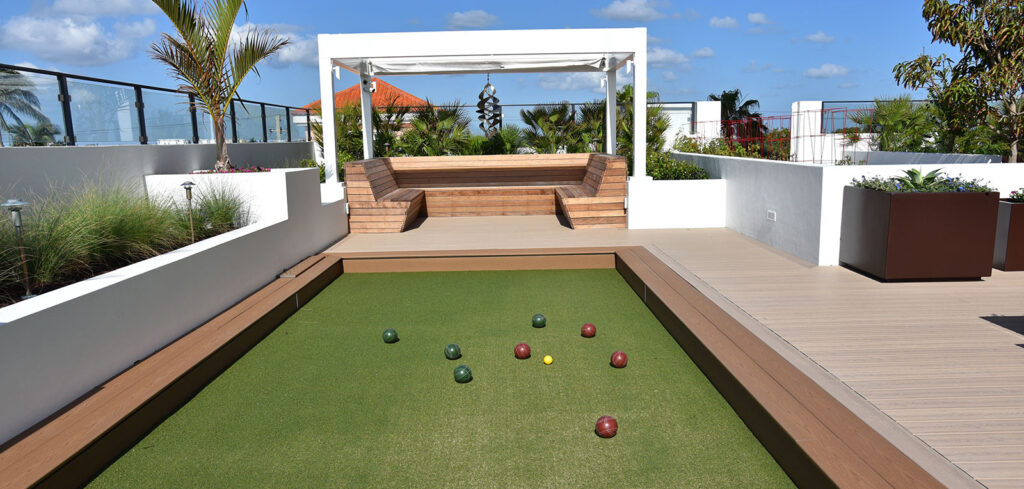
The history of bocce ball, as Italy’s national bocce federation tells it, starts with stone balls rolled across rough ground in what is now Turkey around 7000 B.C. The game spread through the Roman Empire and medieval Europe, then took its organized modern form in northern Italy between 1873 and 1904. Bocce simply means “balls” in Italian, and immigrants carried it to America.
Key Takeaways
- Bocce is the plural of the Italian boccia, “ball.” You will also see it spelled bocci or boccie.
- The oldest evidence Italy’s federation cites is a set of stone balls from Çatalhöyük, Turkey, dated to about 7000 B.C.
- Kings of France and England banned the game again and again, blaming neglected work, betting and fights.
- Turin opened Italy’s first bocce club in 1873, and Italian emigrants spread the game across the Americas in the early 1900s.
- A Special Olympics court is 60 by 12 feet. The USBF official court is 86.92 by 13.12 feet.
What Does Bocce Mean?
Bocce is the plural of the Italian word boccia, which means “ball.” The same word names the game, so Italians play bocce with a set of bocce. According to the Online Etymology Dictionary, English borrowed the word in 1860.
The deeper root is less settled. That dictionary links boccia to the French bosse, a bump or hump, and possibly to a Germanic source. Other dictionaries trace it to bottia, a Vulgar Latin word for a round body.
You will also see the name spelled bocci or boccie. American dictionaries describe it as an Italian variety of lawn bowling.
Bocce Words Worth Knowing
- Pallino. The small target ball. Rulebooks also call it the pallina or the jack, and Italian dictionaries use boccino.
- Frame. One round, played from one end of the court until every ball is thrown and points are counted.
- Pointing. Rolling a ball softly so it stops close to the pallino.
- Hitting or shooting. Throwing hard enough to knock an opposing ball out of position.
- Raffa, volo and pétanque. The three styles of play that Italy’s federation governs today.
Where Did Bocce Originate?
The Italian Bocce Federation’s official history starts at Çatalhöyük, a Neolithic town in Turkey. Stone balls found there, dated to about 7000 B.C., show clear wear from rolling over uneven ground. The federation adds that similar, more carefully shaped balls turned up in Egypt, Greece and Rome.
What the Romans Added
The same history credits Roman legions with carrying the game into Gaul, roughly modern France, and into Britain. It later grew strongly in both places. That is why many accounts of the origin of bocce ball start with Rome, even though ball-rolling games are far older.
Tradition Versus Record
Treat the ancient chapter as tradition backed by scattered finds. Old stone balls show that people rolled balls at targets, not that anyone played by bocce’s rules.
Banned by Kings: Bocce in Medieval and Renaissance Europe
By the Middle Ages, people played in streets, town squares and castle grounds. Nobles and commoners both loved it. The Italian federation says that popularity caused trouble: neglected work, betting and the odd furious argument mid-game.
Rulers pushed back. The federation counts six royal bans in France and England, the last in 1511. English kings Edward III, Richard II and Henry VIII all outlawed it or games like it.
The game still had fans in high places. In the late 1400s, doctors at the University of Montpellier believed it eased rheumatism. Erasmus, Martin Luther and John Calvin all approved of it, and Calvin was a keen player.
Venice issued a harsh edict against the game in 1576. By the late 1600s, Charles II of England had legalized it and ordered a set of rules. In 1753 a booklet by Raffaele Bisteghi, printed in Bologna, explained how Italians played it, local variations and all.
How Bocce Became Italy’s Game
Organized bocce in Italy began in the northwest. Turin founded the country’s first bocce club, the Cricca Bocciofila, in 1873. On November 14, 1897, fifteen Piedmont clubs met in nearby Rivoli to coordinate play, and the Unione Bocciofila Piemontese formed in Turin the next year.
Italy’s first official rulebook arrived in 1904. Games then were played outdoors, on open ground with no borders, using wooden balls. Clubs from Liguria and Veneto joined in 1919, creating the Unione Bocciofila Italiana. Italy’s Olympic committee, CONI, recognized it in 1926.
After 1929, when a state recreation agency took over the sport, Italy adopted one national rule set. A new “synthetic” ball, made of sawdust mixed with glue, helped make that possible. The national body is now called the Federazione Italiana Bocce.
A Timeline of the History of Bocce Ball
Dates through 1919 come from the Italian federation. Later dates come from the USBF and Special Olympics.
| Year | What happened |
|---|---|
| About 7000 B.C. | Stone balls worn by rolling are left at Çatalhöyük, Turkey |
| Roman era | By tradition, legions carry the game into Gaul and Britain |
| Middle Ages | Kings of France and England issue repeated bans |
| Late 1400s | Montpellier doctors recommend it for rheumatism |
| 1511 | Henry VIII of England issues another ban |
| 1576 | Venice issues an edict against the game |
| 1753 | Raffaele Bisteghi publishes a rules booklet in Bologna |
| 1873 | Turin opens Italy’s first bocce club |
| 1898 | Unione Bocciofila Piemontese forms in Turin |
| 1904 | Italy publishes its first official rulebook |
| 1919 | Unione Bocciofila Italiana forms |
| 1976 | Chris Gerardo founds the United States Bocce Federation |
| 1991 | Bocce becomes a Special Olympics sport |
How Italian Immigrants Brought Bocce to America
The American chapter in the history of bocce ball began with Italian families. The Italian federation notes that around the time of its 1904 rulebook, emigrants were spreading the game through many countries in the Americas.
Bocce ball suited new arrivals well. It cost little, it worked on almost any flat ground, and it pulled neighbors together. The Smithsonian’s National Museum of American History keeps a ball from a set owned by John P. Bargetto, who came to the United States in 1909 to join his brother, a California winemaker. The museum calls the game an important part of immigrant community life.
National organization came later. Chris Gerardo of Pueblo, Colorado, founded the United States Bocce Federation in 1976 and led it until 1985. The USBF calls itself the only internationally sanctioned governing body for bocce in the United States.
Special Olympics added bocce in 1991. In 2011 alone, 216,929 Special Olympics athletes in 162 programs competed in it.
How to Play Bocce Ball: The Basic Rules
House rules vary, but most games follow the same pattern. This summary draws on the Special Olympics bocce rules and the USBF open rules.
- Split into two sides: singles, doubles or teams of four. Each side gets four balls in its own color, eight in all.
- Toss a coin. The winner throws the pallino, which must stop past the center line and short of the far foul line.
- The side that threw the pallino rolls the first ball.
- The other side rolls until it gets closer or runs out of balls. From then on, the side that is not closest rolls next.
- Deliver underhand. You can roll, bank off the side boards or knock an opposing ball away.
- Score once all eight balls are played. Only one side scores, earning a point for each ball closer than the other side’s best ball.
- The scoring side throws the pallino to open the next frame.
If the two closest balls belong to different sides and are dead even at the end, nobody scores that frame. Special Olympics singles and doubles play to 12 points and four-player teams to 16. USBF games usually go to 12, with finals to 15.
Bocce Court Dimensions: Regulation vs Backyard
There is no single court size. Each organization sets its own, and the USBF says unofficial courts can be smaller than its official one.
| Court | Length | Width | Source |
|---|---|---|---|
| USBF official | 86.92 ft | 13.12 ft | US Bocce Federation |
| Special Olympics | 60 ft | 12 ft | Special Olympics rules |
| Recreational | 66 ft | 12 ft | Supplier planning guide |
| Recreational, narrow | 60 ft | 10 ft | Supplier planning guide |
| Casual backyard | What fits | What fits | USBF allows smaller |
Lines and Boards
- Foul line. Special Olympics marks it 10 feet from each backboard. The USBF recommends a single line 13 feet from the back wall.
- Half-court line. On a 60-foot Special Olympics court it sits at 30 feet, and the pallino must stop beyond it.
- Walls. Any rigid material works. Special Olympics calls for end walls at least 6.3 inches high and side walls at least 3.15 inches, with 2-inch lines.
Surfaces That Play Well
Special Olympics allows stone dust, dirt, clay, grass or an artificial surface. The USBF lists carpet, crushed stone, dirt, oyster shells, clay, synthetic carpet and poured surfaces on courts around the country.
For an oyster shell court, one shell supplier recommends a 3 to 4 inch layer over crushed stone, framed with 2 by 10 inch pressure-treated boards.
Siting and Care
- Location. One court planning guide suggests a flat, sunny spot away from trees, roof edges and low areas where water collects.
- Base. Start with drain rock, cover it with landscape fabric, then top it with compacted crushed stone.
- Upkeep. Sweep a shell court after play. On a home court, broom, wet and roll it about once a month.
Our own crews handle the base work and surfacing for custom residential courts and larger sport court construction projects. Bocce is one of many games on our full list of sports we build for. For another slow, strategic backyard classic, read what to know about shuffleboard.
Tip: Permit rules vary from town to town. Read our guide on when a backyard sports facility needs a permit before anyone breaks ground.
Frequently Asked Questions About Bocce Ball
What is the small ball in bocce called?
The small target ball is the pallino, also called the pallina or the jack. Italian dictionaries use boccino. It is not always white. Special Olympics rules only ask for a color that stands out from both teams’ balls and a diameter between 1.875 and 2.5 inches.
What are bocce balls made of?
The oldest known balls were stone. Italian clubs around 1904 still used wooden balls, and a synthetic ball of sawdust and glue later caught on in Italy. Special Olympics allows wood or a composition material today. The current USBF standard for tournament balls is about 4.2 inches (106 to 107 mm) across and about 2 pounds (900 to 920 grams).
Was bocce ever an Olympic sport?
No. Some histories place bocce at the 1896 Athens Games, but that program had nine sports: athletics, cycling, fencing, gymnastics, shooting, swimming, tennis, weightlifting and wrestling. The 1900 Paris Games did include two French boules contests, but only as non-medal events. Bocce’s big stage today is Special Olympics, which added it in 1991.
How much space do you need for a backyard bocce court?
Start from the court you want to copy. A Special Olympics court is 60 by 12 feet, and one court planning guide lists 60 by 10 feet as a recreational size. The USBF says unofficial courts can be smaller, so a shorter court still works for family games.
Bring Bocce Home With a Custom Court
My Backyard Sports designs and builds bocce ball courts with a proper base, sturdy borders and a true rolling surface, along with basketball, pickleball, tennis and multi-sport courts. We serve New Jersey, New York, Connecticut, Austin and Houston.