
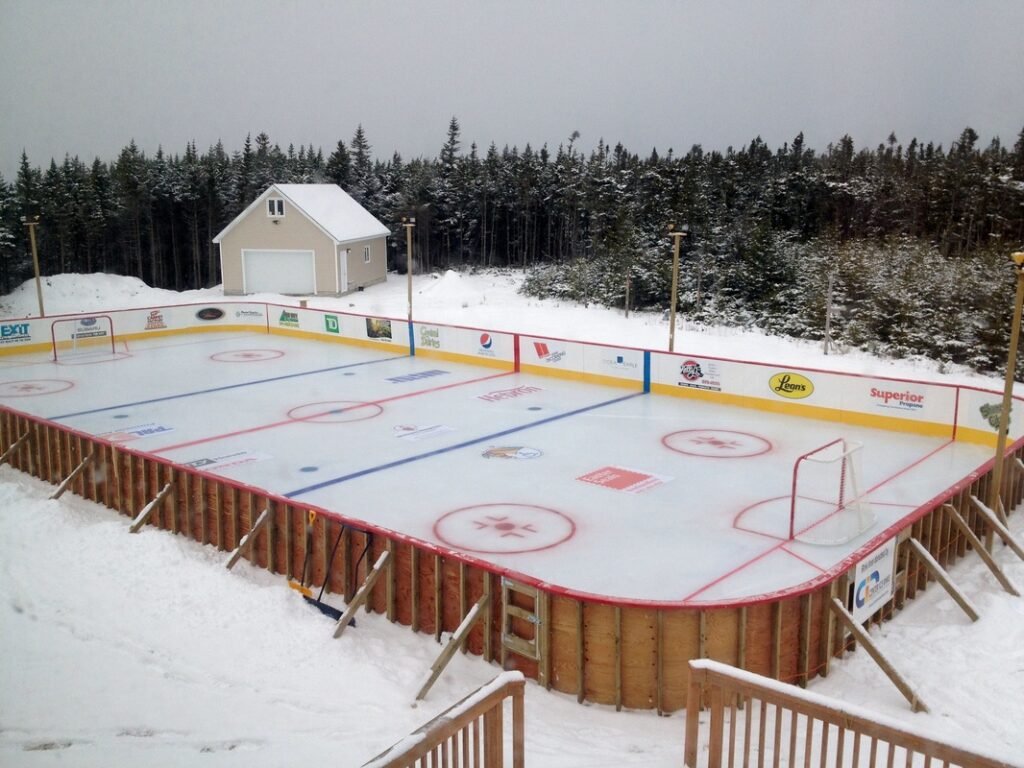
A backyard hockey rink comes in four main forms. You can flood a natural ice rink each winter, make ice with a refrigerated chiller, skate year round on synthetic ice panels, or play roller and dek hockey on a sport tile court. Your climate, budget and how many months you want to play decide which one fits.
Key Takeaways
- A do-it-yourself natural ice rink can cost as little as $200, but it needs several days of weather below 24°F before you flood.
- The average January high in Central Park is 39.5°F, so natural ice near New York City is hit or miss.
- Refrigerated ice does not wait on a cold snap, but installed backyard rinks run $3,000 to more than $34,000, and refrigerated setups cost more.
- Synthetic ice works in any weather, but even the best panels have 10 to 15 percent more friction than real ice and dull blades fast.
- A sport tile court gives you roller hockey, dek hockey and other sports all year.
Backyard Hockey Rink Options Compared
Every backyard hockey rink trades cost against season length. Here are the four main choices side by side.
| Option | Playing season | Published cost | Upkeep |
|---|---|---|---|
| Natural ice | Only during long cold spells | $200 to $1,800 DIY, kits $2,000 to $8,000 | Flooding, shoveling, resurfacing |
| Refrigerated ice | Most of the cold season | Installed rinks $3,000 to $34,000+, more with a chiller | Snow removal, chiller checks, power bill |
| Synthetic ice | All year, indoors or out | $25 to $55 per sq ft (indoor rinks) | Sweeping, washing, frequent skate sharpening |
| Sport tile court | All year outdoors | $4 to $17 per sq ft installed, plus base | Sweep, blow or hose it off |
These ranges come from HomeGuide’s national cost guides, not quotes. Site work, boards, goals and lights add to every option.
Natural Ice Rink Kits: The Classic Winter Build
A natural rink is a frame of boards, a waterproof liner and a lot of water. The HomeGuide ice rink cost guide prices a do-it-yourself build with sidewalls and a liner at $200 to $1,800, and a complete kit at $2,000 to $8,000, depending on who installs it.
The catch is weather. The City of Toronto’s instructions for its community natural ice rinks say to wait until frost reaches at least 2 inches into the ground and the weather will stay below 24°F for several days before flooding.
That kind of cold is not a given near the coast. National Weather Service normals for Central Park show an average January high of 39.5°F and low of 27.9°F, so a flooded rink there can thaw and refreeze all winter.
If you have the cold and the patience, our guide to building your own backyard ice rink covers the site, liner, flooding and spring teardown step by step.
Refrigerated Rinks: Ice You Can Count On
A refrigerated rink works like a giant freezer. A chiller pumps a cold fluid, usually salt brine or water mixed with antifreeze, through pipes under the ice, so water on top freezes even when the air is too warm.
That is how city rinks run long seasons. Central Park’s Wollman Rink, a refrigerated outdoor rink, is scheduled to open daily from October 24, 2026 through March 16, 2027.
- Purchase price. HomeGuide puts a professionally installed backyard rink at $3,000 to more than $34,000, with refrigerated options costing more.
- Running cost. Outdoor rinks carry ongoing water and electricity bills.
- Power. A chiller runs on electricity, so have a licensed electrician check your panel and plan the circuit first.
- Ice temperature. HomeGuide puts rink ice at about 22 to 29°F, with hockey ice kept a little colder than figure skating ice.
The payoff is control. You make ice on your schedule instead of waiting for a cold snap. For families fighting the cost and scarcity of youth hockey ice time, that reliability matters.
Tip: Rink chores call for safety gear. The City of Toronto requires helmets and ice creepers (traction cleats) for anyone flooding or shoveling snow off its community rinks.
Synthetic Ice: Year-Round Skating in Any Climate
Synthetic ice is a floor of slick plastic panels that you skate on with real blades. With no water, chiller or weather to watch, a synthetic ice rink is the practical way to skate in most Austin or Houston yards.
The most common panel material is high-density polyethylene (HDPE), and some makers now use ultra-high-molecular-weight polyethylene (UHMW-PE). HomeGuide puts indoor synthetic ice rinks at $25 to $55 per square foot.
Be realistic about the feel. Even the slickest UHMW-PE panels have 10 to 15 percent more friction than real ice. Most synthetic surfaces also dull skate blades within 30 to 120 minutes, so plan on more sharpening.
Upkeep is light: HomeGuide lists sweeping, washing with soap and water, a weekly deep clean and applying a lubricant. Hockey setups tend to be small, about 50 by 50 feet, and suit shooting and goalie training more than full games.
Roller and Dek Hockey Courts on Sport Tiles
For many families, the most used backyard hockey rink has no ice at all. A sport tile court lets kids play roller or inline hockey on skates, or dek hockey in sneakers with a ball, any day the ground is dry.
Hockey tiles are built for puck travel. VersaCourt, the tile system we install, gives its Compete tile tiny raised pinheads that lift the puck so it glides, and its Boost Outdoor tile adds drainage perforations and expansion joints. VersaCourt says its tiles stay up to 50 percent cooler than concrete or asphalt.
Tiles float over a hard, flat base. The HomeGuide sport court cost guide puts tiles at $4 to $17 per square foot installed, plus $3 to $10 per square foot for the base. It names a 4 inch pad of 4,000 psi concrete with 1/2 inch rebar as the ideal base.
The big advantage is range. Add rebounder boards and two goals and you have a dek hockey court. Paint basketball or pickleball lines on the same modular sport tiles and the whole family plays twelve months a year.
How to Choose the Right Backyard Hockey Rink
- Natural ice. Your winters bring long stretches below 24°F and you enjoy regular flooding.
- Refrigerated ice. You want a dependable winter in New Jersey, New York or Connecticut and can budget for a chiller and its power bill.
- Synthetic ice. You need real skating in a garage, a small yard or a warm climate.
- Sport tile court. You want the most playing days per year and room for other sports.
- A combination. You can mix options, such as a tile court outside for the warm months and synthetic panels in the garage for skating drills.
New to the sport? Our look at the benefits of youth hockey covers skating, teamwork and how kids get started.
What to Plan Before Building a Hockey Rink in Your Backyard
- Measure the flat space. Size the rink to your level ground, not to a pro sheet. The official NHL rulebook sets a rink at 200 by 85 feet, far more than any yard needs.
- Check the slope. Water pools in the low corner of a flooded rink, and tiles need a flat, hard base.
- Plan the boards. NHL boards stand 40 to 48 inches high, with 42 inches ideal. Backyard boards can be lower, so pick a height that suits your players.
- Choose goals and backstops. An NHL goal opening is 6 feet wide by 4 feet high. Hang netting behind each goal to protect windows and siding.
- Bring utilities close. Flooding takes a lot of water, so a nearby spigot helps, and a chiller needs power, so talk with a licensed electrician early.
- Add lighting. Winter evenings get dark early, so good lights turn school nights into skating nights.
Frequently Asked Questions About Backyard Hockey Rinks
How big should a backyard hockey rink be?
Build to the flat, level space you have, not to a pro sheet. An NHL rink is 200 by 85 feet, while hockey synthetic ice rinks usually run about 50 by 50 feet. HomeGuide sizes multi-sport half courts that include hockey at 900 to 2,100 square feet, or about 30 by 30 to 42 by 50 feet. Longer sheets leave room for small games as well as drills.
Can you play hockey on sport court tiles?
Yes. Modular sport tiles are a standard surface for roller, inline and dek hockey. Hockey tiles use a raised surface texture so the puck glides instead of dragging, and outdoor versions drain through the tile. Add boards, goals and lines, and the same court can host basketball or pickleball too.
Is synthetic ice as good as real ice?
Not quite, but it is close enough for training. Even the best panels have 10 to 15 percent more friction than frozen ice, so strides feel heavier, and most synthetic surfaces dull blades within 30 to 120 minutes. It works best for shooting drills and goalie training rather than full games.
How much does a backyard hockey rink cost?
It depends on the type. HomeGuide puts a do-it-yourself natural ice rink at $200 to $1,800 and a professionally installed backyard rink at $3,000 to more than $34,000, with refrigeration costing more. Synthetic ice runs $25 to $55 per square foot for indoor rinks. Sport tiles cost $4 to $17 per square foot installed, plus $3 to $10 for the base.
Can you have a backyard ice rink in a warm climate?
Natural ice needs several days of hard freezing, so it is not practical in places like Austin or Houston. The National Weather Service says Austin’s January lows average in the low 40s, and its official station drops below freezing on only about 12 days a year. In warm climates, synthetic ice or a tile court for roller and dek hockey is the realistic choice.
Plan Your Backyard Hockey Rink With Our Team
My Backyard Sports builds ice and multi-sport hockey rinks, sport tile courts and residential courts across New Jersey, New York, Connecticut, Austin and Houston. We measure your space, recommend a layout and handle the base, surfacing and lines.