
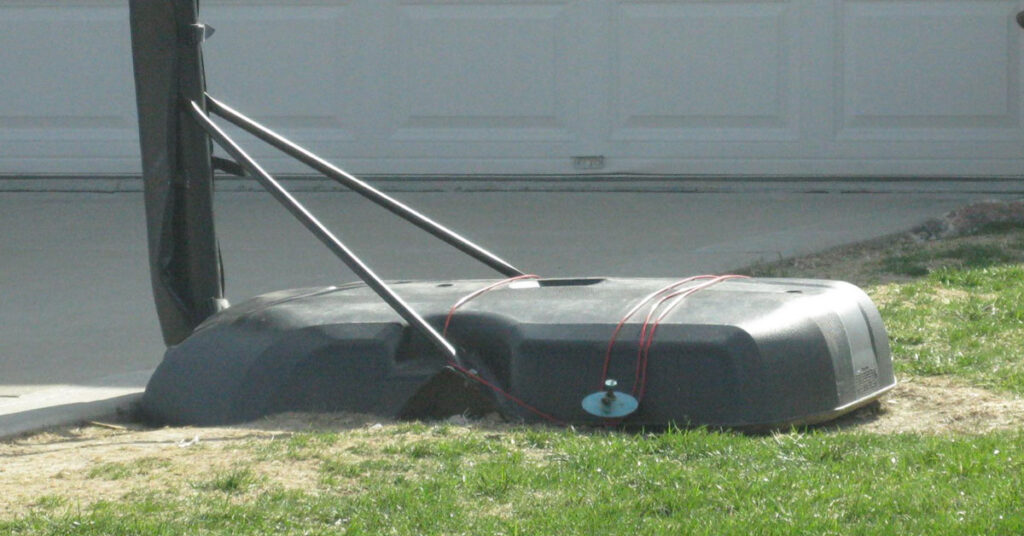
Portable basketball hoop safety comes down to keeping the hoop from tipping over. The usual causes are an underfilled or leaking base, a player hanging on the rim, and strong wind. Fill the base completely, ideally with sand, check it before every session, keep players from hanging on the rim and let only adults adjust or move the hoop.
Key Takeaways
- Fill the base all the way, ideally with sand. One Lifetime model takes 310 pounds.
- Never pile bricks, cinder blocks or cement bags on the base.
- Rim hanging and wind are the classic tip-over causes. Lifetime tests its hoops to 40 mph winds.
- Only adults should raise, lower or roll the hoop, with fingers clear of moving parts.
- Players who dunk belong on an in-ground hoop with 2 to 4 feet of overhang.
Why Do Portable Basketball Hoops Tip Over?
A portable hoop is a long lever. The rim can ride as high as 10 feet on a steel pole, and the only counterweight is a hollow plastic base filled with sand or water.
Anything at the top of that pole has a lot of leverage over the base. Lose some counterweight to a slow leak, or add a swinging teenager or a hard gust, and the hoop can topple. Nearly every portable basketball hoop safety rule traces back to that lever.
Goalrilla’s buying guide says portable goals cannot handle rough play such as dunking because they can tip. It adds that the blow-molded base is usually the first part to fail.
| Trigger | Fix |
|---|---|
| Base not completely full | Fill it to capacity before standing the hoop up |
| Water leaking from the base | Switch to sand, or check daily while water is in it |
| Weights stacked on top | Remove them and fill the base instead |
| Players hanging on the rim | Brief grab to regain balance only, then let go |
| Wind or a coming storm | Stop play, then shelter the hoop or lay it down |
| Base slid or set on gravel | Roll it on its wheels and park it on a smooth surface |
Hanging on the Rim
Hanging on the rim puts a player’s full weight at the top of the lever. Lifetime’s warning label allows only a brief hang to regain balance or avoid hurting someone, then says to let go.
Wind and Storms
Wind pushes on the backboard like a sail. Lifetime says it tests its hoops with water in the base and that they handle winds up to 40 mph without tipping over.
That margin is thin. The National Hurricane Center puts tropical storm winds at 39 to 73 mph, sustained.
Lifetime’s label says not to play in windy or severe weather and to keep the hoop out of the wind and away from overhead power lines. Before a big storm, shelter it or lay it down.
How to Weigh Down a Portable Hoop the Right Way
The base is the whole safety system, so fill it completely. Lifetime’s manual for the 50 inch Quick Adjust (model 90678, a 31 gallon base) calls for 310 pounds of sand. The label warns that an unfilled system standing upright will tip quickly.
Sand vs Water: Which Keeps the Hoop Standing?
Sand is the safer fill. Lifetime says it is about 45% denser than water, and its manual recommends sand because a leaking water base can drain unnoticed and let the hoop fall.
Water is easier to drain before a move. If you use it, the manual says to check for leaks daily and to empty the base for winter, since freezing water can expand and crack it. The catch with sand: once it is in, Lifetime says the base is hard even for a strong adult to move.
Why Cinder Blocks on Top Are a Bad Idea
Stacking bricks, cinder blocks or cement bags on a half-empty base is a common shortcut, and Lifetime’s own filling guide calls it very dangerous. The blocks also put hard, sharp edges right where players land.
Where to Park the Base
Use a smooth, hard surface. Lifetime’s label says the ground under the base must be free of gravel, because a puncture can cause a leak and a tip-over.
Keep it off the lawn too. The label says to keep water and organic material, such as grass, away from the pole base because they could cause corrosion.
Portable driveway basketball hoops sit near cars and the street, so place yours where loose balls roll toward the yard, not the road.
The Pole and Base Sit Right Where Players Land
Overhang is the distance from the pole to the backboard. Goalrilla calls it an important safety feature because it lets players move under the basket without hitting the pole, and it suggests about 2 to 4 feet.
A portable also has a wide, hard base on the ground at the foot of the pole. Spalding’s The Beast portable, for example, has a base about 63 by 36 inches. Lifetime’s label says never to climb or play on the base or pole.
In 2002, a sharp bolt on the playing side of the pole led to recalls of Lifetime and Escalade portables. The CPSC notice says players were cut bumping the pole while driving to the basket.
The fix was free cap nuts. Check that no bolt sticks out on the playing side, and add a pole pad, which Goalrilla says helps limit injuries.
How to Adjust, Move and Assemble a Portable Hoop Safely
- Adjusting. On Lifetime’s 90678, the rim adjusts from 8 to 10 feet with a broom handle, and the manual says only adults should do it. Keep hands and fingers clear of moving parts.
- Moving. Drop the hoop to its lowest height, tip it onto its wheels and roll it. Sliding the base can damage it, start a leak and cause a tip-over. The label says children should never move or adjust it.
- Assembly. Plan on two capable adults. Assemble the pole sections exactly as shown, since the manual warns they can separate during play or transport otherwise.
Portable Hoop Recalls the CPSC Has Announced
Recalls show where portables fail in real life: the base, the bolts and the arm that holds the backboard.
| Year | Product | Hazard | Units |
|---|---|---|---|
| 1997 | Lifetime ProCourt | Base could leak its water | Over 29,800 |
| 2002 | Lifetime and Escalade portables | Sharp bolt on the player side of the pole | About 1.7 million and 16,000 |
| 2002 | Huffy portables | Sharp bolt on the player side of the pole | About 70,000 |
| 2022 | Spalding Momentous EZ | Arm welds could fail and drop the backboard | About 13,400 |
In the Spalding recall, the company had 26 reports of weld failures, three backboard separations and two people struck, one on the head. Before buying a used portable, search its brand and model on the CPSC recalls site.
Portable Basketball Hoop Safety Checklist
This schedule follows the warning label and maintenance steps in Lifetime’s manual.
- Before each session: base full, no cracks or wet spots, no loose hardware, no wobble at the pole or rim.
- Daily with a water base: look for leaks. If you find one, lay the hoop down and do not play on it.
- When wind picks up: stop play. Shelter the hoop or lay it down if a storm is coming.
- Monthly: check the portable basketball pole and metal parts for rust or chipped paint, then clean and repaint. Replace any steel part rust has eaten through.
- After any damage: never play on damaged equipment. Replace a bent or broken rim or a cracked backboard first.
- Before the first freeze: drain a water base and lay the system down for winter.
When Is an In-Ground Hoop the Safer Choice?
A portable suits renters and young shooters who will not hang on the rim. Once players dunk or play hard every day, the counterweighted base becomes the weak point.
An in-ground hoop is anchored in a concrete footing, so there is no base to leak or tip. Anchors still need checkups, though. A 2009 CPSC recall covered about 1,700 Spalding in-ground hoops whose base bolts could fail.
See what makes a solid system in the elements of a quality basketball hoop, why a tempered glass backboard matters, and every style, including over-the-door minis, in basketball hoop types and their pros and cons. Our crews build residential sport courts, hoop installation included.
Frequently Asked Questions About Portable Hoop Safety
Are portable basketball hoops safe for kids?
Yes, with conditions. The base must be completely full, the hoop must sit on a smooth, gravel-free surface, and an adult should handle every height change and move. The risk climbs when kids hang on the rim, climb on the base or play in wind.
Should I fill a portable basketball hoop with sand or water?
Sand, in most cases. It is denser, which makes the hoop harder to tip, and Lifetime recommends it because a leaking water base can empty without anyone noticing. Water makes sense only if you move the hoop often. Then check for leaks daily and drain it before freezing weather.
How much wind can a portable basketball hoop handle?
It depends on the model and how full the base is. Lifetime says its water-filled test systems handle winds up to 40 mph without tipping, barely above the 39 mph where tropical storm winds begin. Stop play when it gets windy, and shelter the hoop or lay it down before a storm.
Can you dunk on a portable basketball hoop?
It is risky. Goalrilla’s buying guide says portable goals cannot handle heavy or rough play like dunking because they can tip or fall. Lifetime’s label allows only a brief hang on the rim to regain balance, and hanging from the rim voids its warranty. Players who dunk need an in-ground system built for it.
Done Worrying About a Wobbly Portable Hoop?
My Backyard Sports sells and installs basketball hoops and builds home courts in New Jersey, New York, Connecticut, Austin and Houston. Tell us about your driveway or yard, and we will measure the space and recommend a layout.