
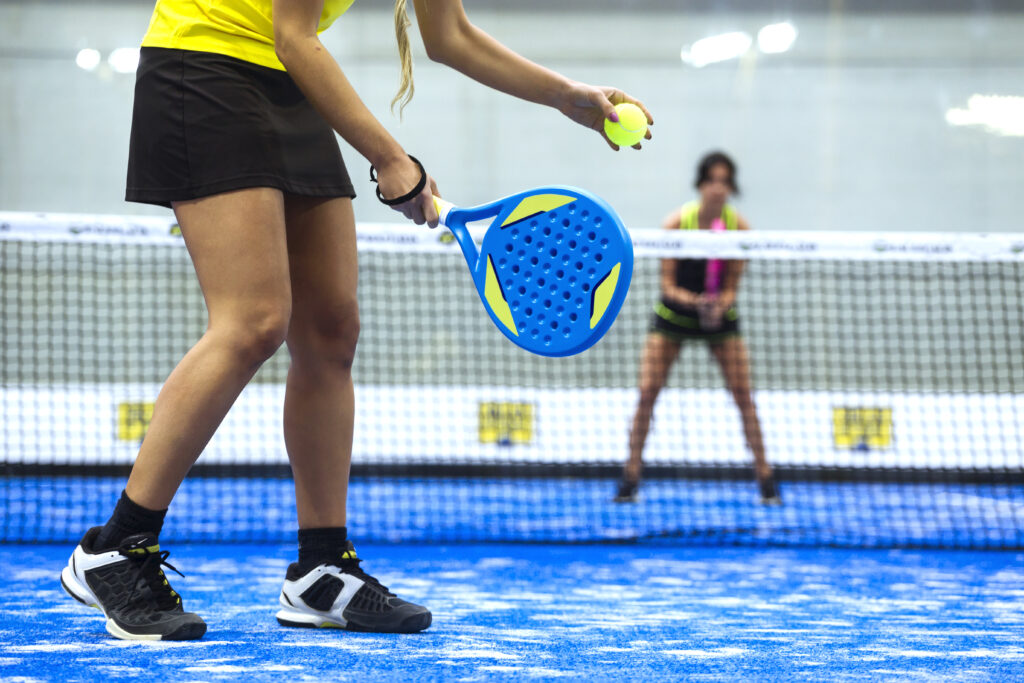
Padel vs pickleball comes down to walls, court size and gear. Padel is mostly played in pairs inside a 65.6 by 32.8 foot (20 by 10 m) enclosure of walls and mesh, with a stringless racket and a pressurized ball that can rebound off the walls. Pickleball uses an open 20 by 44 foot court, a solid paddle, a plastic ball with holes and a 7-foot kitchen.
Key Takeaways
- The footprints are close: a padel court is about 2,153 square feet inside its walls, and USA Pickleball recommends a 34 by 64 foot surface for new courts.
- Height is the big difference. Padel end walls reach about 13 feet (4 m), and the rules call for about 19.7 feet (6 m) of clear space overhead.
- Padel servers get two tries and the ball stays live off the glass. Pickleball servers get one try, and the kitchen shapes every rally.
- Pickleball has far more players: about 24.3 million Americans in 2025, against about 1.07 million for padel.
Padel vs Pickleball Side by Side
Padel figures come from the FIP Rules of Padel in force from January 1, 2026. Pickleball figures come from the 2026 USA Pickleball Official Rulebook.
| Feature | Padel | Pickleball |
|---|---|---|
| Playing area | 65.6 by 32.8 ft (20 by 10 m) inside the walls | 20 by 44 ft, lines included |
| Enclosure | Required: walls plus mesh | None, open court |
| Net height | 34.6 in at center, 36.2 in at the ends | 34 in at center, 36 in at the sidelines |
| Serve | Bounce it, then hit at or below the waist | Underhand volley serve, or a drop serve after a bounce |
| Serve attempts | Two | One per server |
| Serve clips the net and lands in | Replayed | In play |
| Walls in a rally | Playable after the ball bounces | No walls |
| Zone at the net | None, volley anywhere | 7 ft non-volley zone (the kitchen) |
| Scoring | 15, 30, 40, game; best of three sets | Serving side scores; games to 11, win by 2 |
| Hitting tool | Stringless perforated racket, up to 17.9 in long | Solid paddle, up to 17 in long |
| Ball | Pressurized rubber ball | Molded plastic ball with holes |
| Format | Mostly doubles | Singles or doubles |
Padel Court vs Pickleball Court Size: What Your Yard Needs
The footprints are close. Padel’s walls fix its size, while pickleball’s depends on the room you leave around the lines.
| Layout | Dimensions | Area |
|---|---|---|
| Padel court, inside the enclosure | 65.6 by 32.8 ft (20 by 10 m) | 2,153 sq ft |
| Pickleball court, lines included | 20 by 44 ft | 880 sq ft |
| Pickleball minimum playing surface | 30 by 60 ft | 1,800 sq ft |
| Pickleball, recommended for new builds | 34 by 64 ft | 2,176 sq ft |
FIP measures padel from the inside of the walls, so the frame and posts sit outside that number. Leave extra room to walk around the structure.
Height Is the Real Difference
Each padel end wall stands about 13 feet (4 m): roughly 9.8 feet (3 m) of glass or solid wall, then 3.3 feet (1 m) of mesh. The sides mix wall sections near the corners with mesh in the middle.
FIP requires at least 19.7 feet (6 m) of clear height over the court and suggests 26 feet (8 m) for new facilities. That matters for any indoor build.
Pickleball has no walls, and its rulebook does not require a fence.
Padel Build Details to Plan For
- Surface. FIP allows cement, synthetic surfaces or artificial grass, in green, blue or terracotta tones.
- Lighting. The bottom of each light must sit at least 19.7 feet (6 m) off the ground, on poles outside the court.
- Out-of-court play. Chasing a ball out through the side openings is allowed only with an obstacle-free zone about 10 feet wide and 13 feet long (3 by 4 m) on each side.
Padel vs Pickleball Rules: Serve, Walls and Scoring
The Serve
Both sports serve diagonally across the net. In padel, keep one foot behind the service line, bounce the ball and strike it at or below the waist into the diagonal box. Miss, and you get a second serve.
A padel serve may bounce in the box and then hit the glass, but touching the mesh before the second bounce is a fault. A serve that clips the net and lands in is replayed.
In pickleball, you serve from behind the baseline with a volley serve or a drop serve. The ball must clear the kitchen and land in the diagonal service court. A serve that brushes the net and lands in stays in play, and each server gets one attempt.
Walls Versus the Kitchen
In padel, the walls keep the ball alive. Once it bounces on your side, it can come off the glass or mesh and you can still play it before a second bounce.
You can even hit the ball into your own wall and let it carry over the net. The catch: your shot must land on the other side before it touches their walls.
Pickleball has no walls, so the strategy lives near the net. The serve and the return must each bounce before anyone volleys, and no one may volley from inside the 7-foot non-volley zone.
Our guide on how to play pickleball covers those rules step by step.
Scoring
Padel keeps tennis scoring: 15, 30, 40 and game. Sets go to six games with a two game margin and a tiebreak at six all, and matches are best of three sets.
FIP also allows shorter deuce formats. A golden point settles the game at the first deuce, while a Star Point decides it at the third deuce.
Standard pickleball lets only the serving side score. A game usually goes to 11, won by 2. USA Pickleball also lists rally scoring, where every rally earns a point, as a provisional option.
Padel vs Pickleball Equipment: Racket, Paddle and Ball
A padel racket has no strings. The center of its face is drilled with holes of roughly 0.35 to 0.5 inch (9 to 13 mm). FIP caps it at 17.9 inches (45.5 cm) long, 10.2 inches (26 cm) wide and 1.5 inches (38 mm) thick, and a wrist cord is mandatory.
A pickleball paddle is solid, with no holes or rough texture on its face. Length plus width cannot top 24 inches, and length cannot top 17 inches. Thickness and weight are unlimited.
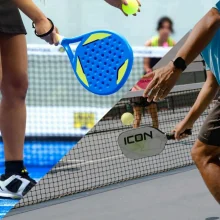
The balls differ too. Padel uses a pressurized rubber ball 2.5 to 2.67 inches (6.35 to 6.77 cm) across. Pickleball uses a smooth molded ball with holes, and outdoor balls customarily have smaller holes.
Which Is Easier to Learn, Padel or Pickleball?
Pickleball usually asks less of a beginner on day one. There are no rebounds to read, and each doubles player covers about 10 feet of width instead of about 16 in padel. The two-bounce rule and the kitchen take some getting used to.
Padel asks for one new skill: letting the ball come off the glass and playing it on the way back. It takes practice, but a ball that gets past you is not always lost, so points tend to run longer.
Tennis players already know its scoring. Read more about the benefits of playing padel.
Padel vs Pickleball: Which Court Should You Build?
Work through these five questions before you pick a court.
- Who will play with you? SFIA counted 24.3 million American pickleball players in 2025 and about 1.07 million padel players. Pickleball partners are easier to find.
- How much flat ground do you have? Plan on about 34 by 64 feet for pickleball, and a little more than 65.6 by 32.8 feet for padel once the frame is added.
- Can you build tall? New Jersey’s construction code exempts fences 6 feet tall or less from permits, so expect to need one for a 13-foot padel enclosure. Read when a backyard sports facility needs a permit before you design.
- Do you want more than one sport? Pickleball lines can share a multi-use court with basketball and other games. Padel needs its own enclosure.
- What is your budget? Walls, a metal frame and mesh make padel the larger project. Our backyard sport court cost guide for Bergen County is a good starting point.
With enough room, you can build both side by side. See our padel and pickleball court builds for ideas.
Frequently Asked Questions About Padel vs Pickleball
What is the difference between padel and pickleball?
Padel is played in a walled court where the ball stays live off the walls after it bounces, with a stringless racket, a pressurized ball and tennis scoring. Pickleball is played on an open 20 by 44 foot court with a solid paddle, a plastic ball, a 7-foot kitchen and games to 11.
Is a padel court bigger than a pickleball court?
In playing area, yes. A padel court covers about 2,153 square feet inside its walls, while a pickleball court measures 880 square feet, lines included. Add the 34 by 64 foot surface USA Pickleball recommends for new courts, and the two footprints are close. Padel is much taller, though, with 13-foot end walls.
Can you play pickleball on a padel court?
Not to regulation. The space fits, since pickleball’s 30 by 60 foot minimum surface sits inside a padel court’s 65.6 by 32.8 feet. The net is close at the center, 34.6 inches (0.88 m) against 34. But it spans the full 32.8 foot width instead of hanging between posts 22 feet apart, and padel courts carry no pickleball lines.
Do you need a permit for a backyard padel court?
In New Jersey, expect to need one. The state construction code exempts fences 6 feet tall or less, but padel end walls stand about 13 feet (4 m). Your town may also limit height and setbacks, and other states set their own codes, so call your building department first.
Still Weighing Padel vs Pickleball?
We will measure your yard, check the space and height each court needs, and recommend a layout. We build padel and pickleball courts in New Jersey, New York, Connecticut, Austin and Houston.