
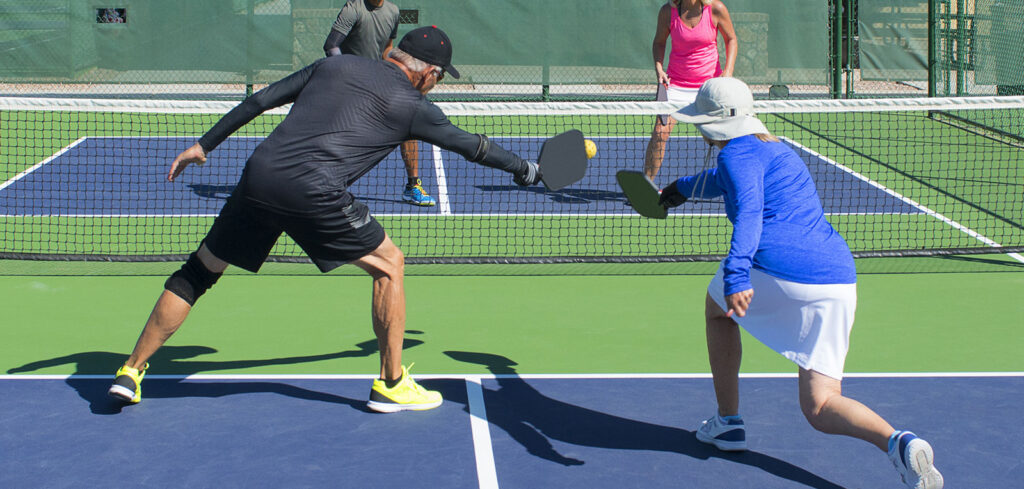
Learning how to play pickleball starts with five rules. Serve diagonally from behind the baseline, one try per server. Let the serve and the return each bounce once before anyone volleys. Never volley while touching the 7-foot non-volley zone, called the kitchen. Only the serving side scores, and most games go to 11 points, win by 2.
Key Takeaways
- The court is 20 by 44 feet for singles and doubles, with a net 36 inches high at the sidelines and 34 inches at the center.
- A serve must clear the kitchen and its line. One that clips the net and lands in is good.
- The kitchen rule limits volleys, not feet. You can step in any time, just not while hitting a ball out of the air.
- Standard doubles scores use three numbers, and every game opens at 0-0-2.
What Is Pickleball?
Pickleball is a paddle sport that borrows from tennis, badminton and table tennis. USA Pickleball traces it to 1965 on Bainbridge Island, Washington, where three dads invented it for their kids.
The Sports and Fitness Industry Association counted 24.3 million American players in 2025. This guide follows the 2026 USA Pickleball Official Rulebook.
Pickleball Rules for Beginners at a Glance
Save this table for your first games, or read USA Pickleball’s short rules summary.
| Rule | What to remember |
|---|---|
| Serve | Volley or drop serve, hit diagonally, one try per server |
| Serve landing | Must clear the kitchen; a net touch that lands in is good |
| Two-bounce rule | Serve and return must each bounce before being hit |
| Kitchen | No volleys while touching the 7-foot zone or its line |
| Line calls | Any line is in, except the kitchen line on a serve |
| Scoring | Only the serving side scores; play to 11, win by 2 |
| Faults | Server’s turn ends; a receiving fault gives the server a point |
Court and Equipment You Need
You need a court, a net, a solid paddle per player and a plastic ball with holes.
| Item | Official spec |
|---|---|
| Court | 20 by 44 ft, same for singles and doubles |
| Kitchen | 7 ft deep from the net on each side |
| Lines | 2 in wide, one contrasting color |
| Net height | 36 in at the sidelines, 34 in at the center |
| Paddle | Up to 17 in long; length plus width up to 24 in |
| Ball | Smooth molded plastic with holes |
By custom, balls with larger holes are used indoors and balls with smaller holes outdoors. The rulebook still approves every listed ball for either setting.
How to Serve in Pickleball
Where to Stand
Stand behind the baseline, between the imaginary extensions of your sideline and the centerline. Keep at least one foot on the ground, and neither foot may touch the baseline or court at contact.
In singles, serve from the right when your score is zero or even and from the left when it is odd. Every server has 10 seconds to serve after the score call.
Two Legal Serves
- Volley serve. Swing your paddle in an upward arc and strike the ball out of the air at or below your waist. At contact, the top of the paddle head cannot be above your wrist.
- Drop serve. Let the ball fall from a natural height, with no toss or push, and hit it after it bounces. The arc and waist limits do not apply.
Either serve may be a forehand or backhand. Do not spin the ball as you release it, though spin from the paddle strike is fine.
Where the Serve Must Land
Each server gets one try, with no second serve like tennis. The ball must clear the kitchen and land in the service court diagonally across. A serve on the kitchen line is out, while one on the sideline, centerline or baseline is in.
A serve that clips the net and lands in the correct court is good.
What Is the Two-Bounce Rule?
The two-bounce rule, also called the double bounce rule, keeps rallies going. The receiver must let the serve bounce before hitting it. Then the serving side must let the return bounce before hitting it.
After those two bounces, anyone may volley. Volley either of the first two shots and your side commits a fault. So the serving team usually waits near the baseline for the return.
Do not confuse it with a rulebook “double bounce,” which means the ball bounced twice on your side. That is a fault.
Kitchen Rules: How the Non-Volley Zone Works
The kitchen is the 7 by 20 foot area touching the net on each side. Its lines are part of the zone, and it covers only the ground, not the air above it.
You may walk in whenever you like and play any ball that bounces there. You just cannot hit a ball out of the air while touching the zone.
- Start every volley outside. If your foot, paddle or anything you wear touches the kitchen during a volley, it is a fault.
- Momentum counts. Stumble into the kitchen after a volley and it is still a fault, even once the ball is dead.
- Reset your feet. After stepping in, get both feet fully outside before your next volley.
Tip: A toe on the kitchen line during a volley is a fault. Set your feet just behind the paint.
Pickleball Scoring: How Points Work and How to Call Them
Standard pickleball uses side-out scoring. Your side scores only while serving and winning the rally. When the receivers win a rally, nobody scores and that server’s turn ends.
Games usually go to 11, win by 2. Tournaments may also play single games to 15 or 21.
Calling the Score in Doubles
Before serving, call three numbers: your team’s score, the opponents’ score, then the server number, 1 or 2. Both partners serve before a side out, except on the opening turn, when the starting team gets one server. That is why games open at 0-0-2.
After each side out, the player on the right serves first. A team’s starting server stands on the right when its score is even and on the left when it is odd.
A Sample Doubles Sequence
- Team A opens at 0-0-2, serving from the right.
- Team A wins the rally. The partners swap sides, and the server calls 1-0-2 from the left.
- Team A loses the next rally. It had only one server, so that is a side out.
- The Team B player on the right serves and calls 0-1-1.
- Team B loses a rally. The partner serves next and calls 0-1-2.
- Team B loses again. Side out, and Team A’s player on the right serves at 1-0-1.
Doubles vs Singles: What Changes
| Rule | Singles | Doubles |
|---|---|---|
| Court size | 20 by 44 ft | 20 by 44 ft |
| Servers per side out | One | Two, except the opening turn |
| Score call | Two numbers | Three numbers |
| Opening call | 0-0 | 0-0-2 |
Rally scoring is a provisional option. Whoever wins each rally scores, the call is two numbers, and in doubles only one partner serves before a side out.
Common Pickleball Faults and Line Calls
A fault ends the rally. If the serving side faults, the server’s turn ends. If the receivers fault, the server wins a point.
- The serve lands outside the correct service court or in the kitchen, line included.
- A shot lands out of bounds or fails to clear the net.
- The ball bounces twice before you return it.
- Someone volleys before the two bounces are complete, or volleys from the kitchen.
- A player, or anything worn or carried, touches the net or its support system while the ball is live.
- The ball hits your body or clothing. Your paddle, and your hands below the wrist while holding it, are exceptions.
Each side calls the lines on its own end. If you cannot clearly see space between the ball and the line, the rulebook says to call it in.
How to Play Pickleball at Home: Court Size and Layout
You need room beyond the lines. USA Pickleball sets the minimum playing surface at 30 by 60 feet, or 1,800 square feet, and recommends 34 by 64 feet for new construction.
Plan for net posts 22 feet apart, inside to inside, and no more than 3 inches in diameter. An optional center strap holds the middle of the net at 34 inches.
Our crews build pickleball courts from the base up and paint pickleball lines to regulation or custom layouts. Browse our backyard court options, check the backyard sport court cost guide, or see how the game compares in our padel vs pickleball guide.
Frequently Asked Questions About How to Play Pickleball
What do you play to in pickleball?
Most games are played to 11 points, and you must win by 2, so a close game can finish 12 to 10 or 13 to 11. Tournaments may also use single games to 15 or 21, still win by 2. With traditional scoring, only the serving side can score, so a game often includes many side outs.
Can you spike in pickleball?
Yes. Nothing in the rules bans an overhead smash. To smash a ball out of the air, wait until it fully crosses to your side and the two bounces are done. Hit from outside the kitchen, and do not let your momentum carry you in. Smash a high ball while standing on the kitchen line and it is a fault.
What is a volley in pickleball?
A volley is any shot you hit before the ball bounces. Volleys are legal once the two-bounce rule is met, as long as you start the shot outside the kitchen. The rulebook says the act of volleying lasts until your follow-through stops, which is why momentum into the kitchen still counts as a fault.
Ready for a Pickleball Court of Your Own?
My Backyard Sports designs and builds backyard pickleball and multi-sport courts, lines and kitchen included. Tell us about your yard in New Jersey, New York, Connecticut, Austin or Houston, and we will measure the space and recommend a layout.