
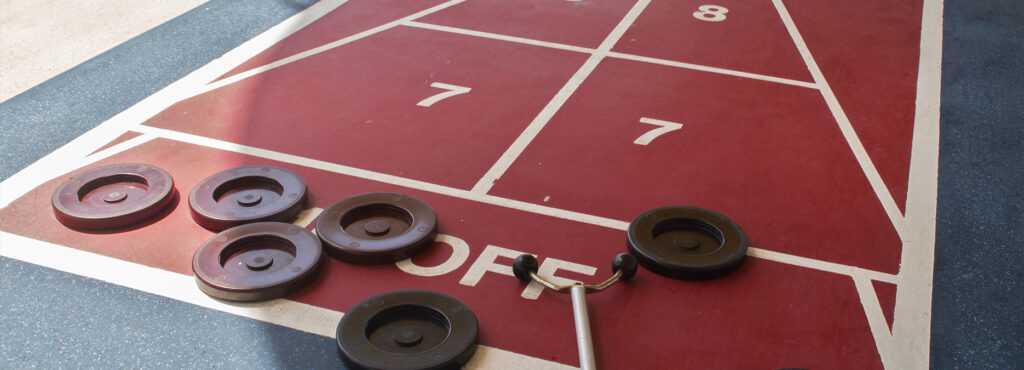
Regulation shuffleboard court dimensions are 52 feet long by 6 feet wide on a smooth concrete slab. The baselines sit 39 feet apart, which leaves a 6 foot 6 inch shooting area at each end. Each scoring triangle is 6 feet wide and 9 feet deep. A 1 foot 6 inch “10 off” band sits between its base and the baseline.
Key Takeaways
- A regulation court is 52 by 6 feet, with 39 feet between baselines and a 6 foot 6 inch shooting area at each end.
- Each scoring triangle has one 10 zone, two 8 zones and two 7 zones. A disc in the 10 off band costs you 10 points.
- A disc only counts if it sits fully inside a zone without touching a line, and both sides can score in the same frame.
- Each player shoots four 6 inch discs with a cue no longer than 6 feet 3 inches.
- Table shuffleboard is a separate game with its own sizes, point values and scoring rules.
1. Shuffleboard Court Dimensions: The Official Layout
The Florida Shuffleboard Association was organized in St. Petersburg in 1928 to standardize court sizes, equipment and rules. Its current rulebook still sets the court at 52 feet long and 6 feet wide, with concrete as the playing surface.
The National Shuffleboard Association court diagram shows the same layout in detail. Use this table when you plan, pour or paint a court.
| Court feature | Measurement |
|---|---|
| Overall court length | 52 feet |
| Court width | 6 feet |
| Playing area, baseline to baseline | 39 feet |
| Shooting area behind each baseline | 6 feet 6 inches |
| 10 off band | 1 foot 6 inches deep |
| Scoring triangle | 6 feet wide by 9 feet deep |
| Each scoring row (7, 8 and 10) | 3 feet deep |
| Triangle tip to dead line | 3 feet |
| Between the two dead lines | 12 feet |
| Painted line width | 3/4 inch to 1 inch |
| Concrete slab thickness | 4 inches minimum |
| Form level tolerance across the width | 1/32 inch maximum |
| Gutter between side by side courts | At least 24 inches wide |
How Long Is a Shuffleboard Court, End to End?
Walk the court from one end. You cross 6 feet 6 inches of shooting area, 1 foot 6 inches of 10 off, 9 feet of triangle and 3 feet to the dead line. That adds up to 20 feet.
The far end mirrors it for 40 feet. Add the 12 feet between the dead lines and you get the regulation length of 52 feet.
Tip: Measure every mark from the center of the line, not its edge. The NSA diagram measures all line dimensions from line centers, and edge measuring shifts each mark by half a line width.
2. Shuffleboard Scoring: How the Triangle Pays Out
The scoring diagram at each end has six areas: one 10, two 8s, two 7s and one 10 off. The 10 sits at the tip of the triangle, the point closest to the players shooting at it. A center line splits the 8 and 7 rows into left and right halves.
- 10 points. The small triangle at the tip.
- 8 points. The middle row, split into two halves.
- 7 points. The widest row, also split in two.
- 10 off. The band between the base of the triangle and the baseline. A disc left here subtracts 10 points.
A disc scores only when it sits completely inside a zone and does not touch a line. The small separation triangle inside the 10 off band is ignored for scoring.
Scores are counted after all eight discs are shot, and each side adds up its own good discs. Unlike table shuffleboard, both sides can score in the same frame, so a frame can end 17 to 10.
How Long Is a Game?
Florida state tournaments usually play best two out of three games to 75 points. Shorter formats play a set number of frames, such as 8, 12 or 16, and the higher total wins.
If the sides are tied at or past game point, play keeps going. Under Florida rules, singles play one more full round and doubles play two, then the higher score wins.
3. What Equipment Do You Need to Play Shuffleboard?
You need eight discs, a cue for each player and something to make the court slick. Here is what the rulebooks specify.
- Discs. A set is eight discs, four yellow and four black, though any two contrasting colors work. Each disc is 6 inches across and 9/16 inch to 1 inch thick, and new discs weigh 15 ounces.
- Cues. A cue can be no longer than 6 feet 3 inches, and no metal part of it may touch the court.
- Court speed. Once the painted lines are dry, the NSA suggests shuffleboard wax or loose glass beads so discs glide.
- Bumpers. The NSA recommends loosely anchored 2 by 2 lumber or 1 inch rope at the ends to stop hard rebounds.
- Scoreboard. On the NSA diagram, the scoreboard marks the head of the court, where every game starts.
4. Shuffleboard Game Basics: How to Play Outdoors
Shuffleboard is played as singles, with two players, or doubles, with four. The goal is to push your discs into the far triangle, keep your opponent from scoring, or both.
- Pick colors. In tournaments, color choice can be settled by a lag: one player from each side shoots toward the far dead line, and the final disc closer to it wins. At home, just agree. Yellow shoots first to start a game.
- Set up. Each player lines up four discs in their half of the 10 off band at the head of the court. Yellow plays from the right side.
- Shoot in turn. Yellow and black alternate until all eight discs are played. Push in one smooth, straight motion, since hook and hesitation shots draw penalties in tournament play.
- Clear dead discs. A disc that fails to reach the far dead line is removed. So is any disc that leaves the court.
- Score the frame. Count every good disc for both sides and post the totals.
- Switch. In walking singles, players walk to the other end and black leads the next half round. In doubles, partners stand at opposite ends, and the color lead changes after both ends have played.
Simple Strategy for New Players
The last disc of each frame is called the hammer. Nobody shoots after it, so use it to knock an opponent into the 10 off band or out of a scoring zone.
With your earlier discs, you have two basic choices. Play for points deep in the triangle, or leave a guard disc short of the triangle to shield a disc that is already scoring.
5. Deck Shuffleboard vs Table Shuffleboard
The two games share a name but little else. Deck shuffleboard is the court game played with cues. Table shuffleboard is played on a long wooden board, and players slide small weights by hand.
| Feature | Deck (court) | Table |
|---|---|---|
| Length | 52 foot court, 39 feet between baselines | Tables run 9 to 22 feet |
| Width | 6 feet | 20 inch playing surface |
| Pieces | 8 discs, 6 inches across | 8 weights, 2 5/16 inches across |
| How you shoot | Cue up to 6 feet 3 inches | By hand |
| Point values | 10, 8, 7 and minus 10 | 1, 2, 3 and 4 for a hanger |
| Who scores | Both sides, every good disc | Only the side with the lead weight |
Under the Shuffleboard Federation’s official table rules, a tournament playing plank is 20 feet 8 inches long and 20 inches wide. It sits in a cradle about 22 feet long. Shorter shuffleboard tables exist, down to about 9 feet.
How to Build a Backyard Shuffleboard Court
The NSA compares building a court to laying a sidewalk, with extra care for leveling and smoothing. These steps follow its published construction guidelines.
- Pick the site. Choose level, well drained ground. Strip the sod down to firm soil and compact it. In cold climates, dig below the frost line and fill back up with crushed rock.
- Set the forms. Use straight 2 by 6 lumber for a 4 inch slab, level to within 1/32 inch across the 6 foot width.
- Reinforce. The NSA calls for seven 1/2 inch rods running lengthwise and 3/8 inch rods crosswise on 12 inch centers, set mid slab.
- Pour two layers. Place 3 1/2 inches of 3,000 psi concrete, then a sand and cement topcoat about 45 minutes later. Add color to the top layer. The NSA calls green by far the most popular court color.
- Cure slowly. Keep wet burlap or sand on the surface for several days. After about seven days, rub the surface lightly with a rubbing brick to remove grit.
- Paint the lines. After about a week of drying, paint lines with white exterior latex concrete paint on a green court.
- Finish. Add wax or glass beads for speed, plus bumpers at each end.
Short on Space? Shorten the Middle Lane
A full outdoor shuffleboard court needs a 52 by 6 foot strip, plus room to walk alongside it. If your yard cannot fit full shuffleboard court dimensions, keep the 6 foot width and both scoring triangles. Shorten the 12 foot lane between the dead lines instead.
The game scores the same way on a shorter court. Shots simply need less speed, which can suit younger players.
Planning Shuffleboard With Other Courts
Shuffleboard pairs well with a larger backyard plan. We design and build custom residential courts, and our crews handle sport court line painting to regulation or custom layouts.
Adding a lane beside a basketball or multi-sport court? Say so early, because the lane needs its own smooth, slick finish. Browse the backyard sports we build, or read about the history of bocce ball, another classic target game.
Frequently Asked Questions About Shuffleboard Courts
How big is an outdoor shuffleboard court?
A regulation outdoor court measures 52 by 6 feet. The baselines are 39 feet apart, with a 6 foot 6 inch shooting area behind each one. Under Florida rules, side by side courts need a gutter at least 24 inches wide between them. A backyard court can run shorter if you keep the width and both scoring triangles at full size.
How do you score in outdoor shuffleboard?
After all eight discs are shot, each side adds up its own good discs. A disc fully inside the 10 zone scores 10, the 8 zones score 8 and the 7 zones score 7. A disc touching any line scores nothing, and a disc in the 10 off band subtracts 10. Florida state tournament games usually run to 75 points, while other games can stop after a set number of frames.
What is the regulation length of a shuffleboard table?
Under Shuffleboard Federation tournament rules, the playing plank is 20 feet 8 inches long and 20 inches wide, set in a cradle about 22 feet long. Shorter tables exist, down to about 9 feet. The court game is a different sport, with a full length of 52 feet and 39 feet between the baselines.
Is shuffleboard a good game for kids?
Yes. There is no running or jumping, so kids, parents and grandparents can share the same court. The rules only cap cue length at 6 feet 3 inches, so a shorter cue works for small players in casual games. A shortened backyard lane helps too, since less power is needed to reach the scoring triangle.
Plan Your Backyard Shuffleboard Court
My Backyard Sports designs and builds shuffleboard and multi-sport courts in New Jersey, New York, Connecticut, Austin and Houston. Tell us about your yard, and our team will measure the space and recommend a layout.